

Google Ads cost about $4.33 per click in the United States, and about $1.61 worldwide. That's the median (the advertiser right in the middle) for Search campaigns across 1,000+ advertisers on AdKit in September 2026 (live numbers here).
But nobody pays "the median".
Google Ads pricing doesn't work like a price list. You bid in an auction, so a quarter of US advertisers pay under $1.80 for a click and a quarter pay over $9.69.
TL;DR: A click on Google Search costs about $4.33 in the US and $1.61 worldwide. A lead costs around $276 in the US and $95 worldwide. Google has no minimum budget, but you need about 10 clicks a day to learn anything, which is about $1,320 a month in the US. And your bill can be bigger than your budget: up to double on a given day, plus fees.
How much do Google Ads cost?
A click on a Google Search ad costs about $4.33 in the United States. That's the median across the 390+ US advertisers on AdKit in September 2026.
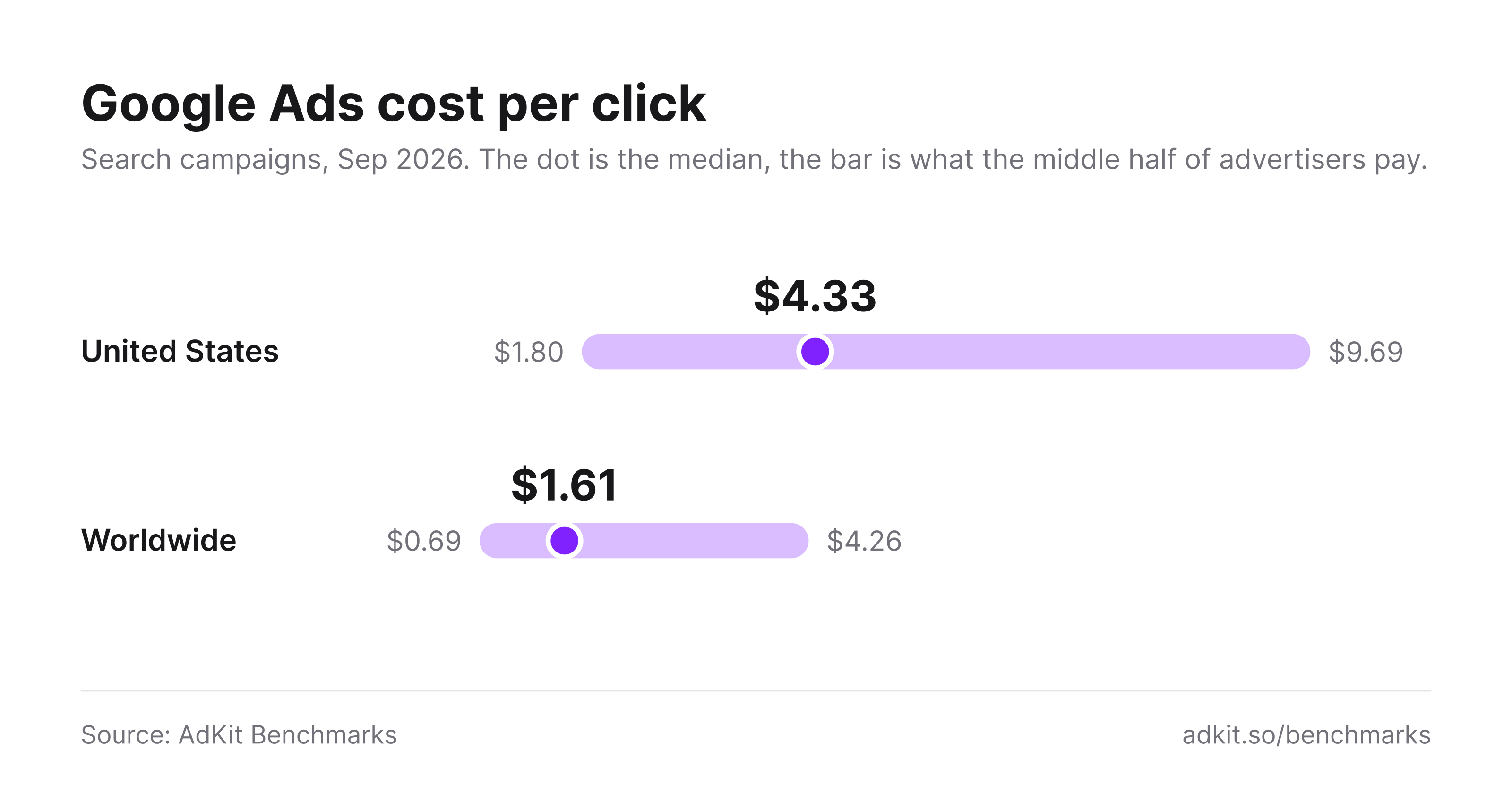
The median is the advertiser right in the middle. The typical range is where the middle half of advertisers falls: a quarter pay less than that, a quarter pay more.
Google sells several kinds of campaigns, and they don't cost the same:
| Median cost per click | Typical range | |
|---|---|---|
| Search, United States | $4.33 | $1.80 to $9.69 |
| Search, worldwide | $1.61 | $0.69 to $4.26 |
| Performance Max, worldwide | $0.66 | $0.24 to $1.79 |
| Display, worldwide | $0.18 | $0.05 to $0.41 |
Why are Performance Max and Display clicks so much cheaper?
Because it's not the same click. On Search, someone typed what you sell.
A Display campaign shows banners on other websites and apps. With Performance Max, Google places your ads wherever it wants across YouTube, Gmail, Maps and the rest. In both cases, most people who see the ad weren't looking for you. Advertisers bid less for someone who wasn't looking, so the click costs less.
So compare campaign types on cost per customer, never on cost per click.
How Google Ads pricing works
Every time someone searches, Google runs an auction between the advertisers who want to show up for that search. You don't pay your bid. You pay just enough to beat the advertiser below you.
That's why prices vary so much. Three things move the price.
1. Your industry.
A click costs what the customer behind it is worth to the advertisers bidding. Google says it itself: industries with high-value customers, like legal services, see higher bids.
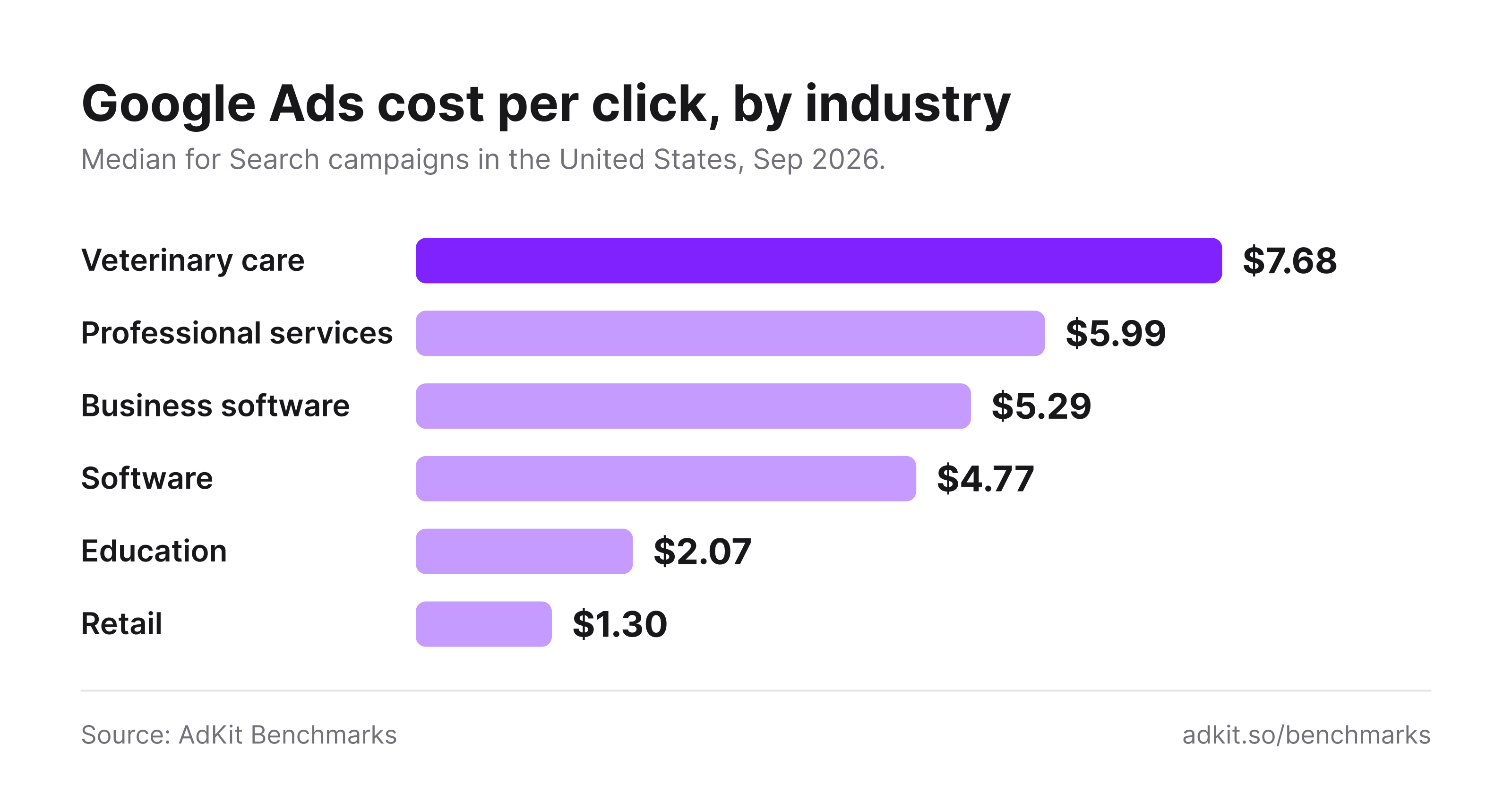
A vet clinic can pay $7.68 for a click because one new client is worth hundreds of dollars. A shop selling $20 items can't, so it doesn't.
| Industry | Median cost per click | Typical range |
|---|---|---|
| Veterinary care | $7.68 | $5.74 to $11.05 |
| Professional services | $5.99 | $1.79 to $11.29 |
| Business software | $5.29 | $4.18 to $8.83 |
| Software and digital services | $4.77 | $3.15 to $8.41 |
| Education and training | $2.07 | $1.16 to $3.15 |
| Retail and commerce | $1.30 | $0.91 to $2.13 |
Every industry and country is on the benchmarks page.
| Industry | Median cost per click | Typical range |
|---|---|---|
| Veterinary care | $7.61 | $5.66 to $10.75 |
| Construction and property | $5.32 | $2.10 to $9.85 |
| Specialty trades | $4.75 | $2.51 to $10.84 |
| Financial and insurance services | $2.39 | $0.62 to $12.04 |
| Medical clinics and practices | $2.13 | $1.39 to $4.89 |
| Business software | $2.01 | $0.83 to $4.79 |
| Software and digital services | $2.01 | $0.93 to $4.71 |
| Education and training | $1.80 | $1.04 to $2.93 |
| Consumer and personal services | $1.78 | $1.36 to $3.52 |
| Design and creative agencies | $1.73 | $1.20 to $6.54 |
| Professional services | $1.24 | $0.51 to $2.86 |
| Apparel and fashion retail | $1.19 | $0.48 to $2.98 |
| Advertising, marketing and PR agencies | $1.15 | $0.47 to $2.55 |
| Manufacturing and industrial | $1.06 | $0.46 to $1.39 |
| Retail and commerce | $1.05 | $0.54 to $1.91 |
| Beauty and personal-care retail | $0.95 | $0.81 to $1.24 |
| Furniture, home and garden retail | $0.90 | $0.39 to $1.90 |
| Media, entertainment and recreation | $0.66 | $0.45 to $1.13 |
| Real estate | $0.58 | $0.47 to $0.85 |
| Property development | $0.58 | $0.48 to $0.71 |
Every industry and country is on the benchmarks page.
2. Where your audience lives.
The US is the expensive one: about 2.7 times the worldwide median.
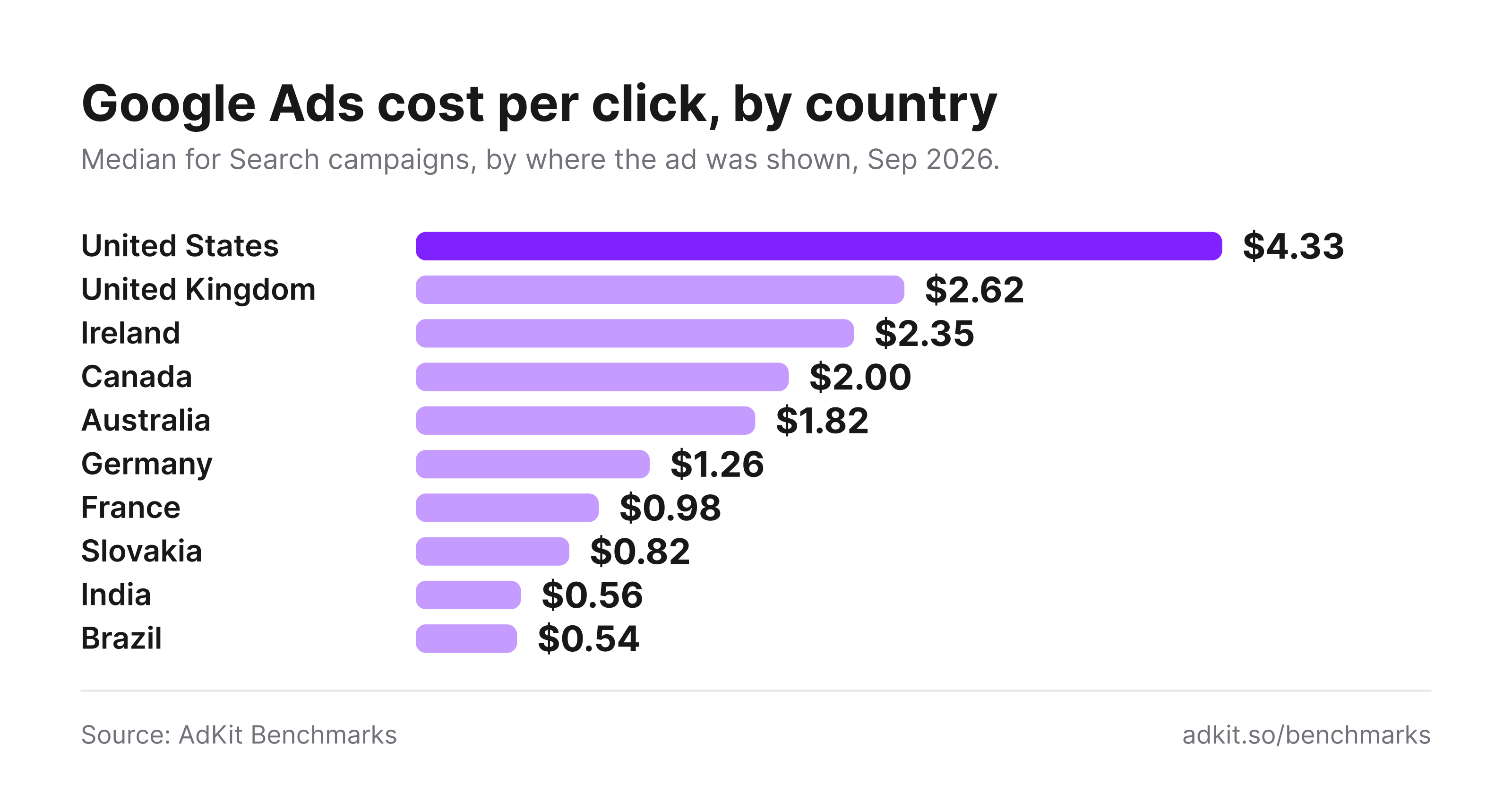
You pay for where the people are, not where you are: a company in Brazil advertising to Americans pays US prices.
| Country | Median cost per click | Typical range |
|---|---|---|
| United States | $4.33 | $1.80 to $9.69 |
| United Kingdom | $2.62 | $1.28 to $5.57 |
| Ireland | $2.35 | $1.48 to $4.36 |
| Canada | $2.00 | $1.04 to $3.14 |
| Australia | $1.82 | $0.91 to $5.25 |
| Germany | $1.26 | $0.61 to $2.60 |
| France | $0.98 | $0.48 to $2.34 |
| Slovakia | $0.82 | $0.32 to $1.18 |
| India | $0.56 | $0.28 to $1.54 |
| Brazil | $0.54 | $0.32 to $0.77 |
More countries are on the benchmarks page.
3. Who sets the bid: you or Google.
When you set bids yourself (manual bidding), the most you agree to pay for a click, your max CPC (cost per click), is a real ceiling. When Google sets them (automated bidding), it isn't.
Google bids more on a search it expects to end in a sale, and less on the others. You get a bid adjusted for every search, which you can't do by hand. You lose the ceiling, so a single click can cost far more than you would ever type in.
One business owner on Reddit, who let Google set the bids with no cap, found a single click billed at $335.80.
Further reading: How ad platforms work
What a lead or a sale costs on Google Ads
Clicks are what you pay for. Leads and sales are what you want.
| Median | Typical range | |
|---|---|---|
| Cost per lead, United States | $276 | $53 to $1,465 |
| Cost per lead, worldwide | $95 | $25 to $365 |
| Cost per phone call, United States | $253 | $101 to $712 |
| Cost per phone call, worldwide | $219 | $76 to $604 |
| Cost per purchase, United States | $64 | $23 to $459 |
| Cost per purchase, worldwide | $51 | $13 to $298 |
These move a lot more than clicks. In the US, half of advertisers pay between $53 and $1,465 for a lead. That's a gap of almost 28 times, against less than 6 times for a click.
The range is that wide because the click price gets multiplied by your conversion rate, the share of visitors who become a lead or a customer. A $5 click on a page where 1 visitor in 10 fills the form is a $50 lead. The same click on a page where 1 in 100 does is a $500 lead.
So if you build your plan on a $276 CPL (cost per lead), remember that half of advertisers do worse than that.
How much should you spend on Google Ads?
Can't I just start with $10 a day and see?
You can. Google will take your $10: its own page says "There's no minimum". It just won't tell you much, and here's why.
At $4.33 a click, $10 buys you two clicks a day. If 1 visitor in 20 becomes a customer, that's one customer every ten days. You'd need months to know if the ads work or if you just got lucky.
So the real question is: can your budget buy enough clicks to learn something?
A common rule among people who run Google Ads for a living is about 10 clicks a day. Jyll Saskin Gales, a Google Ads coach who used to work at Google, says "at least 10 clicks a day". That's her rule, not Google's.
- 10 clicks at $1.80 each: about $18 a day, or $550 a month.
- 10 clicks at $4.33 each: about $43 a day, or $1,320 a month.
- 10 clicks at $9.69 each: about $97 a day, or $2,950 a month.
Google's own figures are in the same range. Its budget tool says half of US advertisers spend between $8 and $76 a day.
To know which of those three lines is yours, look up the median for your industry and country. Then the Google Ads cost calculator does this math with your own numbers.
Why your bill is bigger than your budget
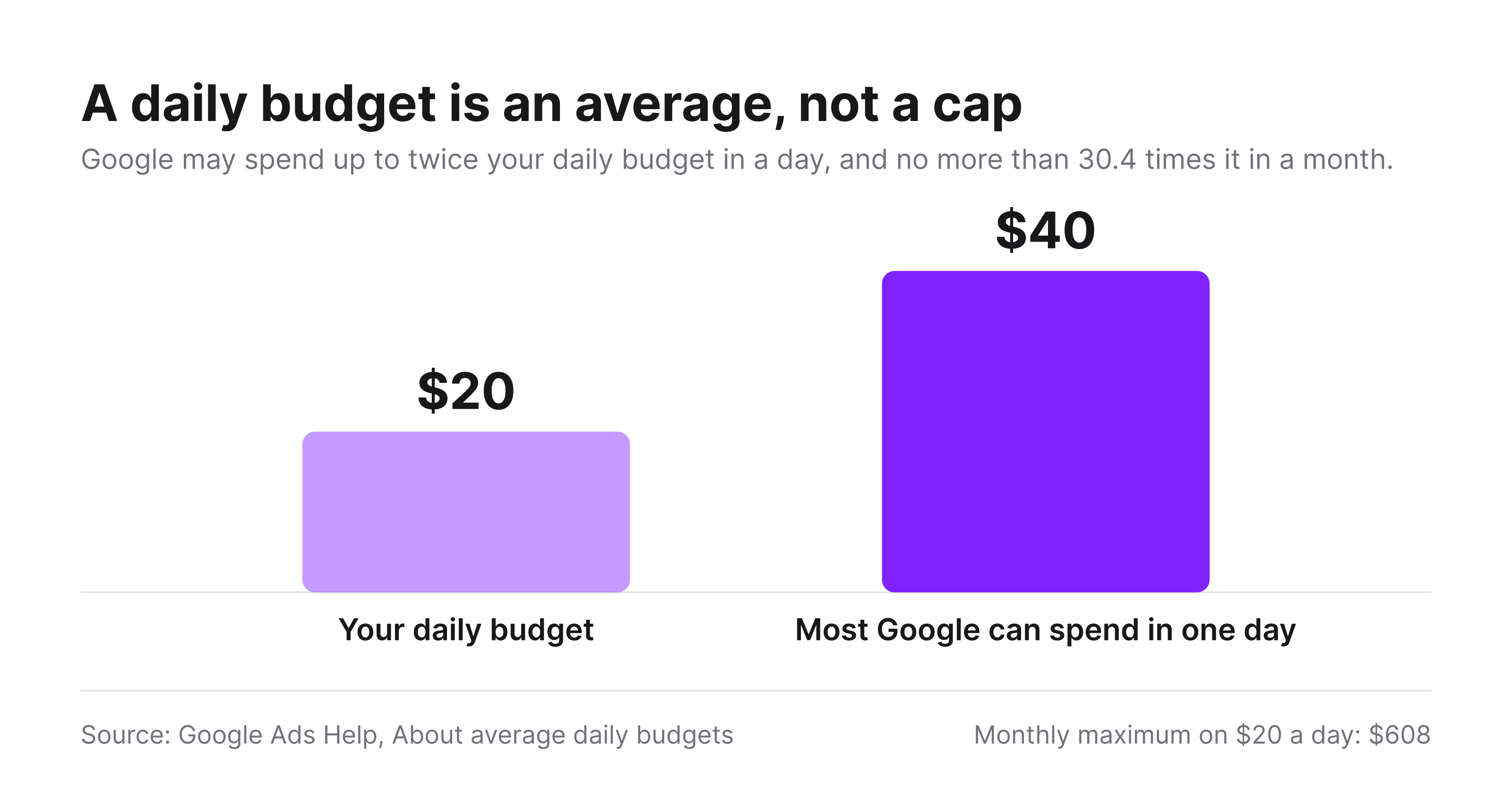
I set $20 a day. Why did Google charge me $40?
Because a daily budget is an average, not a limit.
Google can spend up to twice your daily budget on any given day. On days with lots of searches, it spends more. On slow days, less. Over a month, it won't go above 30.4 times your daily budget (Google's rule).
Four smaller things also show up on your card:
- Several charges a month. Google doesn't bill once a month. It charges you every time your spend reaches a set amount, plus on the 1st. That amount starts small and Google raises it over time. One campaign can mean several charges.
- Fees for some countries. If your ads are shown in Austria (5%), Türkiye (4.5%), Spain (3%), Italy (2.5%), France or the UK (2%), Google adds a fee on top of your budget.
- Charges after you pause. Ads take a few hours to stop, and the last charge can arrive weeks later.
- Google's $500 credit for new advertisers. If you signed up with that offer, it isn't a discount on your first $500. You spend $500 of your own money first, the credit arrives within 35 days, and it only pays for clicks after that.
So when you plan your month, count on budget times 30.4, not budget times the days you planned to run. None of this is hidden, but it's spread over half a dozen help pages.
How to pay less for Google Ads
You can't negotiate with an auction. But a few things are in your hands, and most of them are settings.
Turn on conversion tracking first. Without it, neither you nor Google knows which clicks became customers. The Reddit owner with the $335 click had spent $300,000 over three years before setting it up.
Untick "Display Network" on your Search campaigns. That box sends your unspent Search budget to banners on other websites. Another first-time advertiser lost $225 overnight to it.
Set location to "Presence". The default also reaches people who showed interest in your area without being there. A plumber in Austin doesn't need clicks from Ohio. Leave it on if your customers travel to you, like a hotel.
Read your search terms every week. Broad match, the default, shows your ad on searches Google considers related to your keyword. The search terms report shows what you really paid for. Add the junk as negative keywords, the searches you tell Google never to show your ad for.
Make your ad match the search. If someone types "emergency plumber", the ad and the page it leads to should say emergency plumber. A more relevant ad pays less for the same position.
Google scores this from 1 to 10 for each keyword. It's called the Quality Score, and it looks at three things: whether people click your ad, whether the ad matches the search, and whether your page is useful once they land on it.
Google rates each of the three as above average, average or below average. The auction doesn't use the score itself, so don't chase a 10. Fix whichever part is below average.
Further reading: How to fix a low Quality Score
Are Google Ads worth it?
They're worth it when a customer brings in more than it costs to get one.
Say you make $150 on each customer, and 1 visitor in 20 buys. At $4.33 a click, a customer costs you $87. You keep $63. Good.
Now say your clicks cost what the expensive quarter of advertisers pays: $9.69. The same customer costs $194. You lose $44 on every sale.
Same product, same platform. So before you spend anything, do the math with a bad scenario, not just the average one. The ROAS calculator (return on ad spend) and the ads profit calculator will do it for you.
Give it time before you judge. When Google checks whether its own bidding works, it looks at the last 30 days, with at least 30 conversions.
Where these numbers come from
They're reported by advertisers on AdKit: 1,000+ ad accounts running Google Search campaigns in September 2026, about 390 of them in the United States, from small businesses to agencies running ads for clients. Each account counts once, whatever it spends, and nothing is shown with fewer than 10 advertisers behind it.
The benchmarks page has every number by country, industry, campaign type and month, and it's updated daily.
Final thoughts
These numbers tell you what's normal. They can't tell you what you'll pay, because no row here has your keywords, your city and your landing page in it.
After a month of running ads, your own account is the better source. And inside AdKit, the benchmarks show how your cost per click and click-through rate (the share of people who click after seeing your ad) compare with advertisers like you, so you know whether a $6 click is a problem or just the United States.
Frequently asked questions
Whatever you let Google spend. There is no monthly price: you set a daily budget and Google can spend up to 30.4 times it in a month. A budget that buys 10 clicks a day comes to about $1,320 a month at the US median of $4.33 a click.
It is enough to run, since Google has no minimum. At the US median of $4.33 a click it buys about 2 clicks a day, which is too few to tell whether the ads work.
No. $1 a day is $30.40 a month, about 7 clicks at the US median, which is too few to learn anything. Google's own budget tool says half of US advertisers spend between $8 and $76 a day.
Your spend reached the amount at which Google charges your card (the payment threshold). Google charges you every time you reach it, plus on the 1st of the month, and it raises the threshold on its own as you keep reaching it. $500 is a threshold, not a fee.
On Search, nothing on their own. You pay per click, so 1,000 impressions with no clicks cost $0. CPM (cost per 1,000 impressions) applies to Display and video campaigns, and the benchmarks page has it.
Four pricing models come up: a share of your ad spend, a flat monthly fee, hourly, or a fee tied to results. In Credo's survey of 146 agencies that run paid ads, about 83% work on a flat retainer. Add the fee to your ad spend before you judge what a customer costs you.
A cheaper click is not a cheaper customer. On Google someone typed what they want; on Facebook someone was scrolling. Compare cost per lead or cost per purchase between the two, never cost per click.