

Facebook ads (also called Meta ads) cost about $0.90 per click in the United States, and about $0.37 worldwide. That's the median (the advertiser right in the middle) across 800+ advertisers on AdKit in September 2026 (live numbers here).
But nobody pays "the median".
Facebook ads pricing doesn't work like a price list. You bid in an auction, so a quarter of US advertisers pay under $0.50 for a click and a quarter pay over $1.57.
TL;DR: A click on a Facebook ad costs about $0.90 in the US and $0.37 worldwide. A lead (someone who leaves you their contact details) costs around $37 in the US and $24 worldwide, a sale around $118 and $49. Meta publishes no minimum budget in dollars, but its system needs about 50 results a week, which is about $7,950 a month if you want leads in the US. And your bill can be bigger than your budget: up to 75% over on a given day, plus fees and taxes.
How much do Facebook ads cost?
A click on a Facebook ad costs about $0.90 in the United States. That's the median across the 280+ US advertisers on AdKit in September 2026.
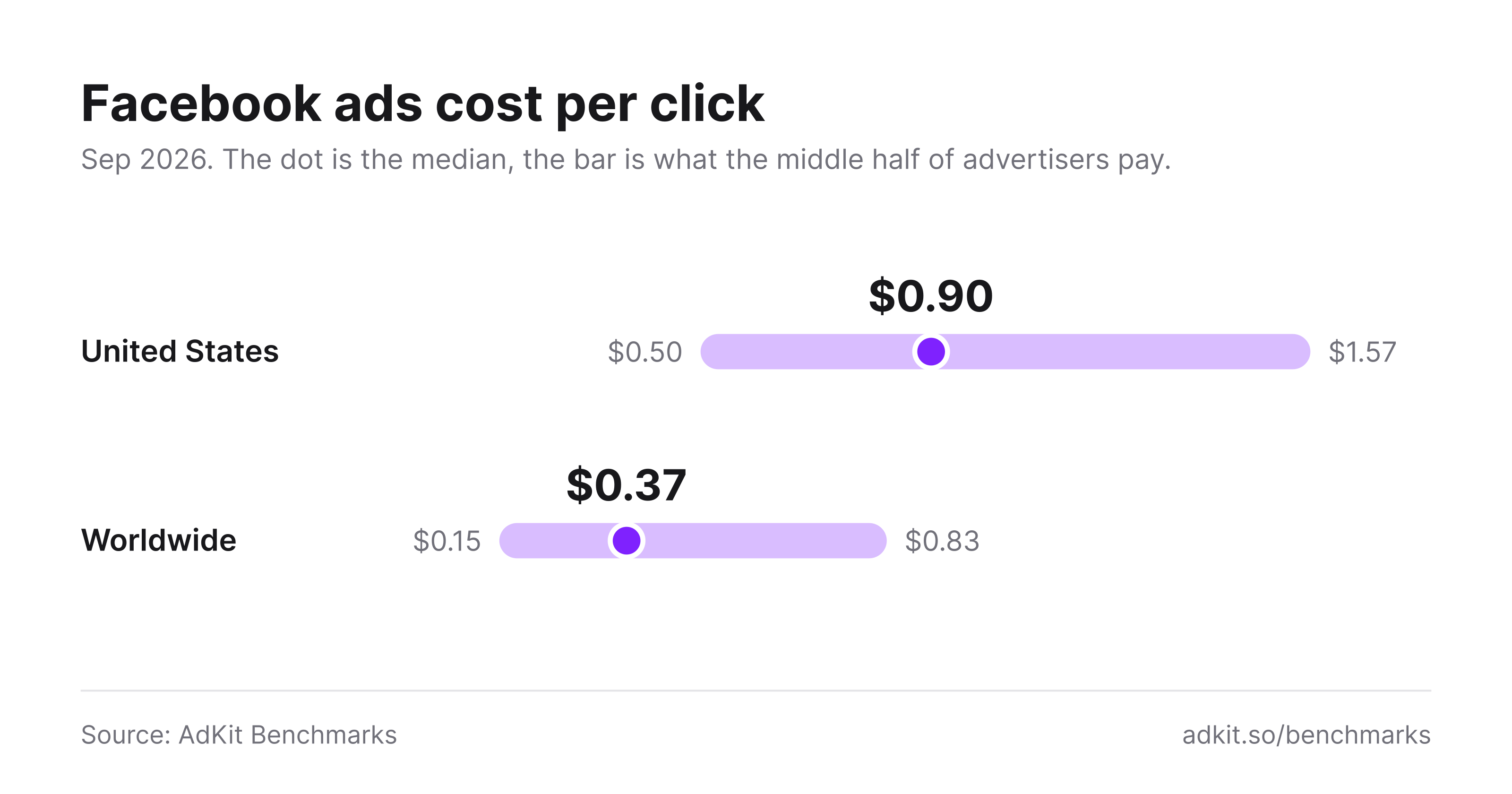
The typical range is where the middle half of advertisers falls: a quarter pay less than that, a quarter pay more.
On Facebook, "cost" can mean three different things, so here are all three:
| Median | Typical range | |
|---|---|---|
| Cost per click, United States | $0.90 | $0.50 to $1.57 |
| Cost per click, worldwide | $0.37 | $0.15 to $0.83 |
| Cost per website visit, United States | $2.63 | $1.17 to $7.55 |
| Cost per website visit, worldwide | $1.38 | $0.44 to $6.30 |
| CPM (cost per 1,000 impressions), United States | $22.75 | $13.59 to $41.34 |
| CPM, worldwide | $9.31 | $3.57 to $19.98 |
Why is a website visit almost three times the price of a click?
Because the click here is what Ads Manager calls "Clicks (all)": every click on your ad counts, including likes, comments and taps on your profile name. A website visit (Meta calls it a landing page view) only counts when someone lands on your page and it loads.
So if you send people to a website, look at the cost per visit. The cost per click will always look better than it is.
Why two advertisers never pay the same price
Every time someone opens Facebook or Instagram, Meta runs an auction between the advertisers who want to reach that person. The highest bid doesn't always win: Meta also looks at how likely that person is to do what your ad asks, and at the quality of the ad. An ad people respond to can win against a higher bid.
That's why prices vary so much. Four things move the price.
1. What you ask Meta to do.
When you create a campaign, you pick a goal: awareness (be seen), engagement (likes and comments), traffic, leads or sales. Meta then shows your ad to the people most likely to do that one thing.
People who click on everything are easy to find, so they're cheap. People who fill a lead form or buy are rarer, so reaching them costs more.
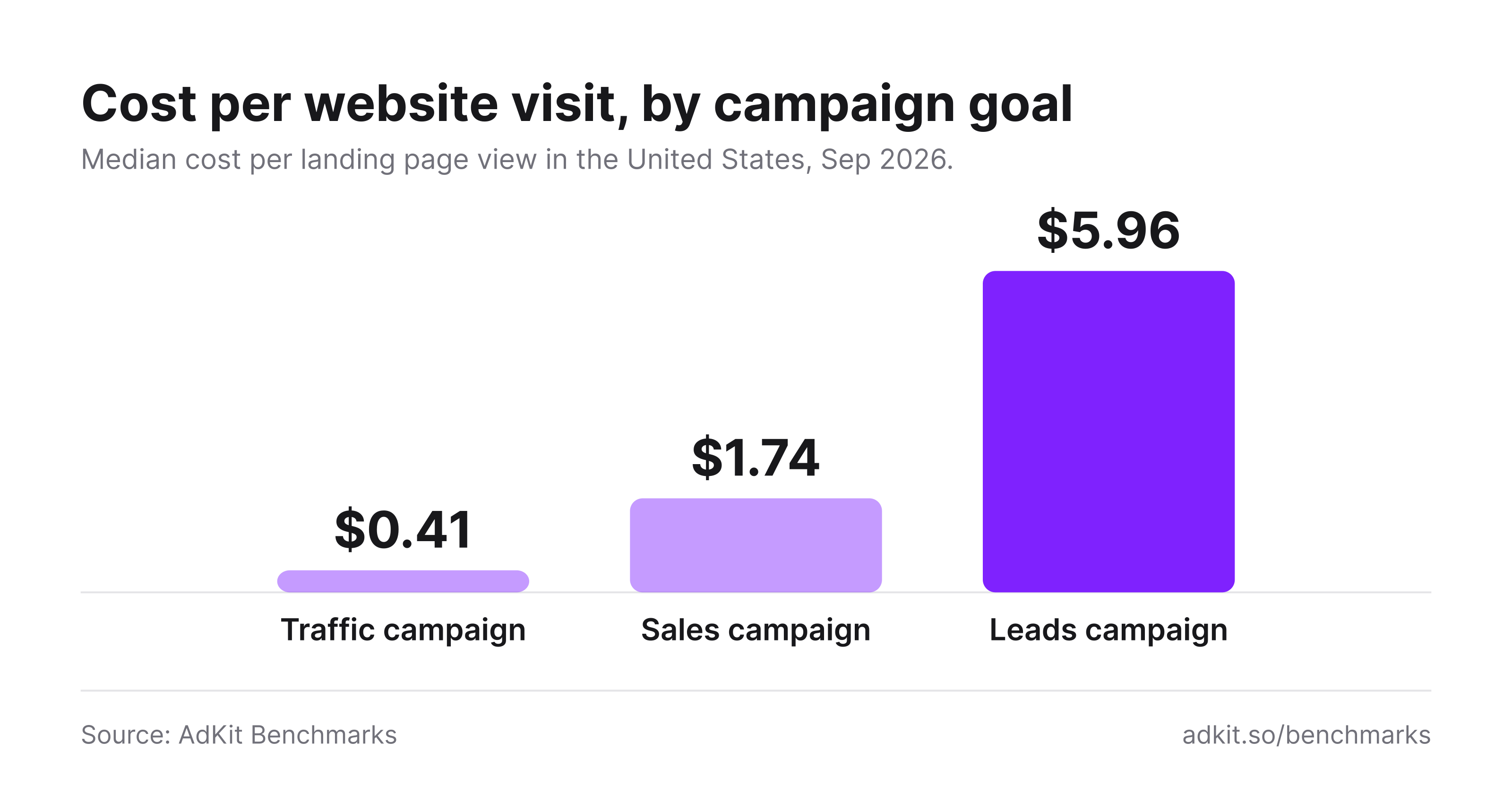
Same website visit, 14 times the price. So never compare your costs with someone running a different goal.
| Campaign goal | Median cost per click | Typical range | Median CPM |
|---|---|---|---|
| Awareness | $1.44 | $1.19 to $3.24 | $3.03 |
| Leads | $1.21 | $0.66 to $2.36 | $27.34 |
| Sales | $0.89 | $0.47 to $1.34 | $21.87 |
| Engagement | $0.76 | $0.46 to $1.26 | $16.21 |
| Traffic | $0.27 | $0.14 to $0.36 | $8.61 |
Awareness campaigns have the cheapest impressions and the most expensive clicks: Meta shows them to as many people as possible, not to people who click.
| Campaign goal | Median cost per click | Typical range | Median CPM |
|---|---|---|---|
| Leads | $0.66 | $0.31 to $1.34 | $16.75 |
| Awareness | $0.56 | $0.20 to $1.28 | $1.16 |
| Sales | $0.34 | $0.15 to $0.75 | $9.22 |
| Engagement | $0.20 | $0.07 to $0.52 | $3.79 |
| Traffic | $0.11 | $0.05 to $0.21 | $4.63 |
2. Where your audience lives.
The US is the expensive one: about 2.4 times the worldwide median.
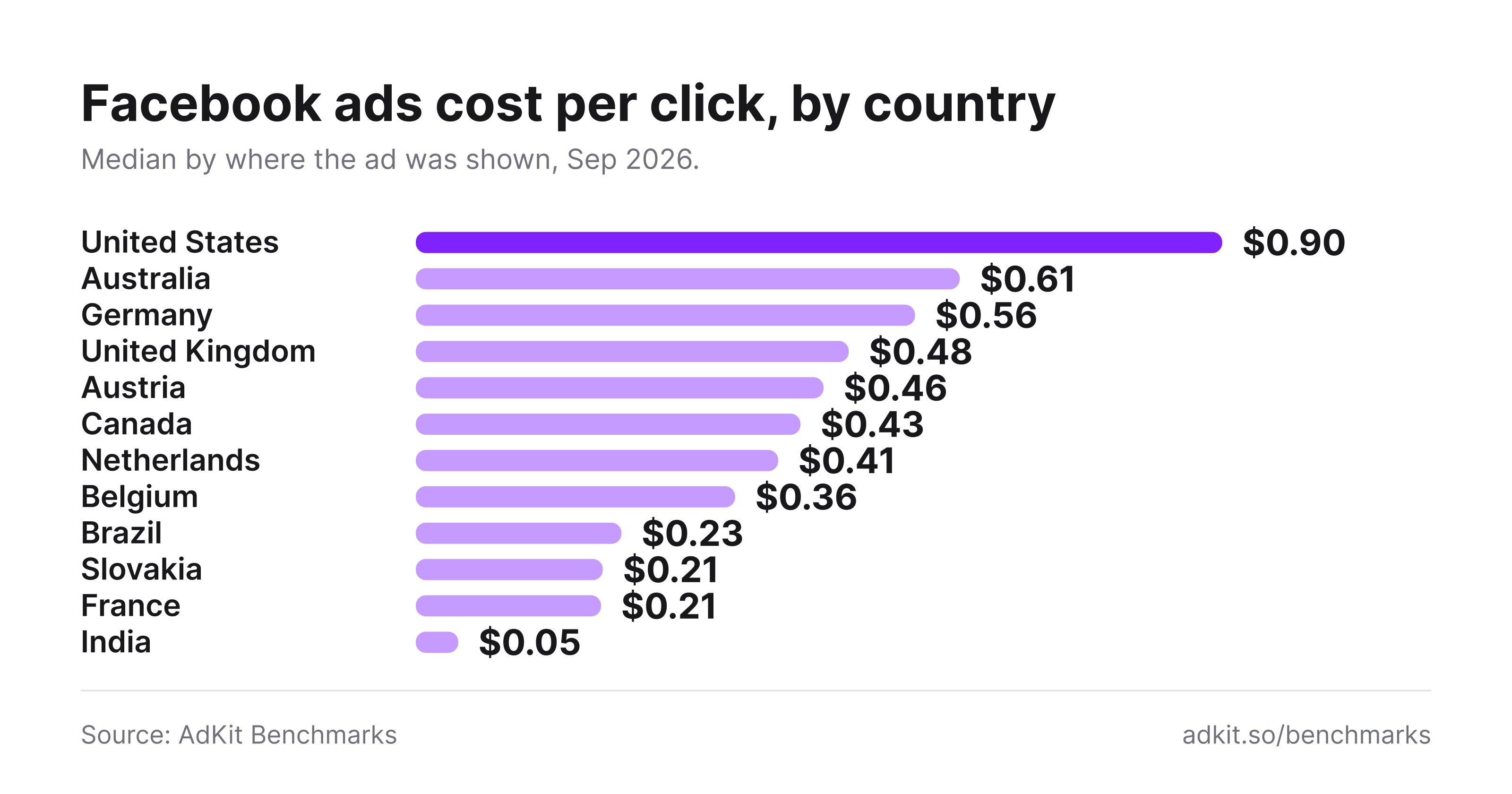
You pay for where the people are, not where you are: a company in India advertising to Americans pays US prices.
| Country | Median cost per click | Typical range | Median CPM |
|---|---|---|---|
| United States | $0.90 | $0.50 to $1.57 | $22.75 |
| Israel | $0.75 | $0.52 to $0.94 | $17.05 |
| Australia | $0.61 | $0.29 to $1.14 | $15.07 |
| Germany | $0.56 | $0.26 to $0.95 | $13.16 |
| Ireland | $0.50 | $0.27 to $0.71 | $12.33 |
| Switzerland | $0.49 | $0.23 to $1.17 | $15.09 |
| United Kingdom | $0.48 | $0.31 to $0.89 | $16.47 |
| Austria | $0.46 | $0.22 to $0.79 | $6.90 |
| Spain | $0.44 | $0.21 to $0.76 | $8.59 |
| Canada | $0.43 | $0.28 to $0.80 | $13.89 |
| United Arab Emirates | $0.43 | $0.29 to $0.99 | $10.28 |
| New Zealand | $0.41 | $0.25 to $0.68 | $9.67 |
| Japan | $0.41 | $0.20 to $0.62 | $8.01 |
| Netherlands | $0.41 | $0.24 to $0.92 | $11.58 |
| Denmark | $0.38 | $0.21 to $0.83 | $11.93 |
| Sweden | $0.38 | $0.23 to $0.79 | $10.06 |
| Belgium | $0.36 | $0.18 to $0.60 | $7.77 |
| Luxembourg | $0.36 | $0.15 to $0.90 | $6.96 |
| Kuwait | $0.34 | $0.18 to $0.46 | $6.59 |
| Qatar | $0.34 | $0.09 to $0.58 | $4.60 |
| Greece | $0.33 | $0.14 to $0.42 | $5.25 |
| Malta | $0.32 | $0.15 to $0.46 | $6.34 |
| Finland | $0.32 | $0.20 to $0.61 | $14.51 |
| Malaysia | $0.30 | $0.15 to $0.40 | $7.00 |
| Norway | $0.29 | $0.18 to $0.64 | $12.46 |
| Slovenia | $0.29 | $0.14 to $0.75 | $8.70 |
| Italy | $0.29 | $0.19 to $0.63 | $9.11 |
| Latvia | $0.29 | $0.21 to $0.37 | $7.31 |
| Czechia | $0.28 | $0.20 to $0.41 | $6.81 |
| Estonia | $0.28 | $0.21 to $0.47 | $4.82 |
| Croatia | $0.27 | $0.10 to $0.36 | $3.06 |
| Poland | $0.25 | $0.14 to $0.48 | $5.73 |
| Portugal | $0.24 | $0.16 to $0.45 | $6.03 |
| Brazil | $0.23 | $0.12 to $0.41 | $4.25 |
| Hungary | $0.22 | $0.16 to $0.26 | $4.36 |
| Bulgaria | $0.21 | $0.13 to $0.35 | $3.24 |
| Romania | $0.21 | $0.18 to $0.35 | $4.21 |
| Slovakia | $0.21 | $0.12 to $0.29 | $4.25 |
| Saudi Arabia | $0.21 | $0.09 to $0.46 | $3.27 |
| France | $0.21 | $0.13 to $0.49 | $7.56 |
| Iceland | $0.20 | $0.14 to $0.47 | $6.12 |
| South Africa | $0.17 | $0.07 to $0.32 | $4.01 |
| Mexico | $0.16 | $0.12 to $0.27 | $4.51 |
| Thailand | $0.13 | $0.09 to $0.19 | $3.25 |
| Colombia | $0.13 | $0.07 to $0.20 | $3.08 |
| Chile | $0.13 | $0.10 to $0.23 | $3.53 |
| Serbia | $0.10 | $0.06 to $0.15 | $2.42 |
| Ukraine | $0.08 | $0.06 to $0.37 | $2.12 |
| Argentina | $0.08 | $0.05 to $0.21 | $2.22 |
| Kenya | $0.07 | $0.05 to $0.10 | $2.89 |
| Vietnam | $0.07 | $0.06 to $0.11 | $2.29 |
| Egypt | $0.07 | $0.03 to $0.12 | $1.65 |
| Tunisia | $0.06 | $0.05 to $0.07 | $0.96 |
| Indonesia | $0.05 | $0.05 to $0.11 | $0.98 |
| Philippines | $0.05 | $0.04 to $0.13 | $2.49 |
| Pakistan | $0.05 | $0.04 to $0.07 | $1.26 |
| India | $0.05 | $0.02 to $0.07 | $0.68 |
Every country, with its history, is on the benchmarks page.
3. Your industry.
It counts, but less than on Google. On Google you bid on a keyword, so lawyers only compete with lawyers. On Facebook you bid on a person, and every industry wants the same people.
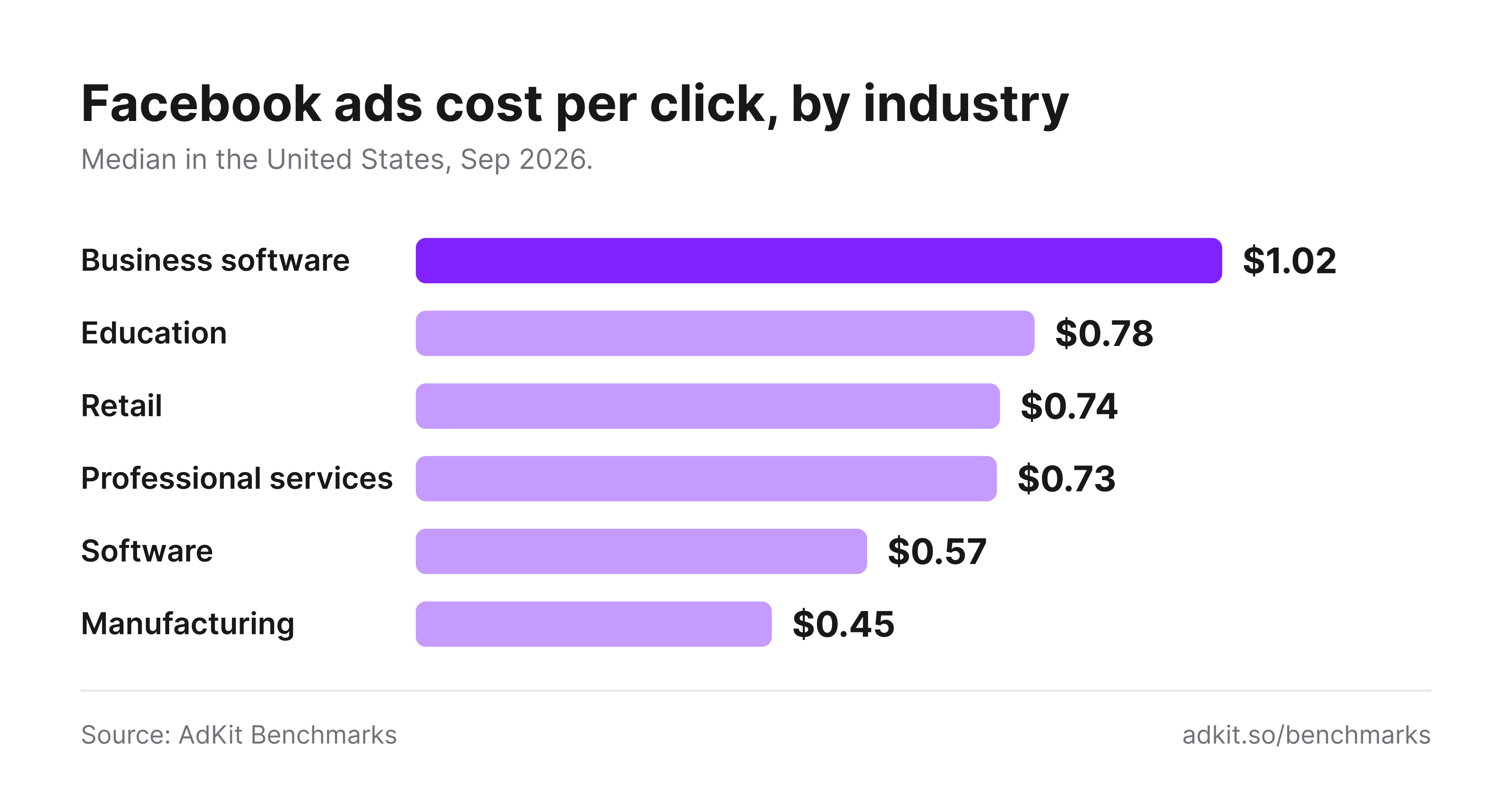
In the US, the gap between the cheapest and the most expensive industry is about 2 times ($0.45 to $1.02 a click). On Google Ads the same gap is about 6 times ($1.30 to $7.68). And between Facebook campaign goals it's about 5 times ($0.27 to $1.44).
| Industry | Median cost per click | Typical range | Median CPM |
|---|---|---|---|
| Business Software | $1.02 | $0.49 to $2.91 | $31.97 |
| Education and Training | $0.78 | $0.58 to $1.25 | $18.89 |
| Retail and Commerce | $0.74 | $0.32 to $1.12 | $20.59 |
| Professional Services | $0.73 | $0.52 to $0.99 | $22.46 |
| Software and Digital Services | $0.57 | $0.35 to $2.34 | $30.08 |
| Manufacturing and Industrial | $0.45 | $0.43 to $0.74 | $14.13 |
| Industry | Median cost per click | Typical range | Median CPM |
|---|---|---|---|
| Construction and Property | $0.75 | $0.39 to $1.73 | $24.99 |
| Education and Training | $0.67 | $0.42 to $1.17 | $16.01 |
| Beauty and Personal-Care Retail | $0.59 | $0.28 to $0.76 | $14.08 |
| Professional Training | $0.50 | $0.12 to $0.97 | $9.76 |
| Consumer and Personal Services | $0.44 | $0.17 to $1.00 | $6.29 |
| Manufacturing and Industrial | $0.43 | $0.28 to $0.67 | $10.19 |
| Property Development | $0.40 | $0.23 to $0.56 | $5.20 |
| Real Estate | $0.40 | $0.21 to $0.64 | $5.37 |
| Business Software | $0.33 | $0.16 to $0.90 | $10.75 |
| Apparel and Fashion Retail | $0.32 | $0.20 to $0.65 | $8.39 |
| Software and Digital Services | $0.30 | $0.15 to $0.79 | $10.52 |
| Retail and Commerce | $0.30 | $0.17 to $0.62 | $9.25 |
| Professional Services | $0.28 | $0.14 to $0.49 | $4.93 |
| Advertising, Marketing and PR | $0.28 | $0.14 to $0.45 | $4.58 |
| Media and Entertainment | $0.18 | $0.12 to $0.26 | $5.14 |
| Healthcare and Life Sciences | $0.17 | $0.10 to $0.53 | $4.91 |
| General and Department Retail | $0.09 | $0.06 to $0.33 | $3.87 |
Every industry and country is on the benchmarks page.
4. The time of year.
Q4 is the expensive quarter. In the US, the median CPM rose 22% from October to November 2025, stayed there in December, then dropped 14% in January.
So if your costs jump in November and you changed nothing, it's probably not you.
Further reading: How ad platforms work
What a lead or a sale costs on Facebook ads
Clicks are what you pay for. Leads and sales are what you want.
| Median | Typical range | |
|---|---|---|
| Cost per lead, United States | $37 | $14 to $102 |
| Cost per lead, worldwide | $24 | $10 to $91 |
| Cost per add to cart, United States | $16 | $7 to $77 |
| Cost per add to cart, worldwide | $9 | $2 to $30 |
| Cost per purchase, United States | $118 | $44 to $254 |
| Cost per purchase, worldwide | $49 | $14 to $148 |
These move a lot more than clicks. In the US, half of advertisers pay between $14 and $102 for a lead. That's a gap of more than 7 times, against about 3 times for a click.
The range is that wide because the click price gets multiplied by your conversion rate, the share of visitors who become a lead or a customer. A $2 visit on a page where 1 visitor in 10 fills the form is a $20 lead. The same visit on a page where 1 in 50 does is a $100 lead.
So if you build your plan on a $118 CPA (cost per purchase), remember that half of advertisers do worse than that.
How much should you spend on Facebook ads?
Can't I just start with $5 a day and see?
You can. Meta will take your $5: it publishes no minimum in dollars, only that minimum budgets vary by country and campaign goal. It just won't tell you much.
Meta's system needs data to figure out who to show your ad to. It says so itself: an ad set (one audience with one budget) stops "learning" after about 50 results in a week. Until then, results are unstable and cost more.
So the real question is: can your budget buy 50 results a week?
At the US medians, that gives:
- 50 website visits a week at $2.63 each: about $19 a day, or $570 a month.
- 50 leads a week at $37 each: about $260 a day, or $7,950 a month.
- 50 purchases a week at $118 each: about $845 a day, or $25,650 a month.
For most small businesses that last line is out of reach. There are two ways around it.
Aim for something that happens more often. If you can't afford 50 purchases a week, optimize for add to cart instead. This is Meta's own advice. In the US, 50 add-to-carts a week cost about $3,500 a month, against $25,650 for 50 purchases. Not everyone who adds to cart buys, but Meta gets enough results to work with.
Put all your budget in one place. Five ad sets at $10 a day each split your results in five. One ad set at $50 a day collects them in one place. Meta's fix for an ad set that can't get enough results is the same: combine them.
To know what 50 results a week cost you, look up the median for your country and industry. Then the Facebook ads calculator does this math with your own numbers.
Why your bill is bigger than your budget
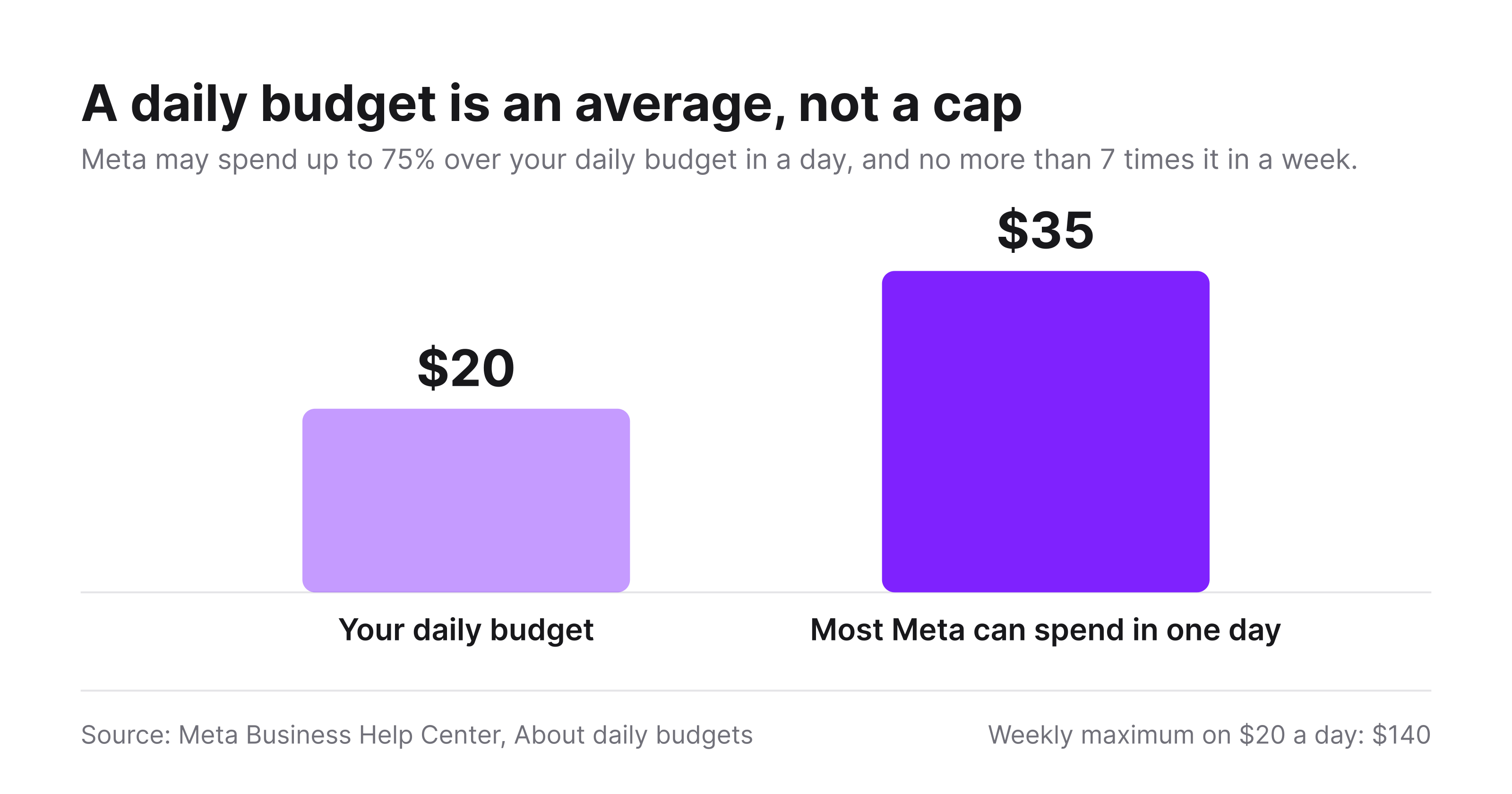
I set $20 a day. Why did Meta charge me $35?
Because a daily budget is an average, not a limit.
Meta can spend up to 75% more than your daily budget on any given day. On days when it sees better opportunities, it spends more. On slow days, less. Over a week, it won't go above 7 times your daily budget (Meta's rule).
Four smaller things also show up on your card:
- Several charges a month. Meta doesn't bill once a month. It charges you every time your spend reaches a set amount, which starts small and grows over time, plus once a month for whatever is left. That's why one ad can mean several charges, and why a charge can arrive after you've stopped your ads.
- A random $1 or $2 charge. That's Meta checking your card. It disappears after a few days.
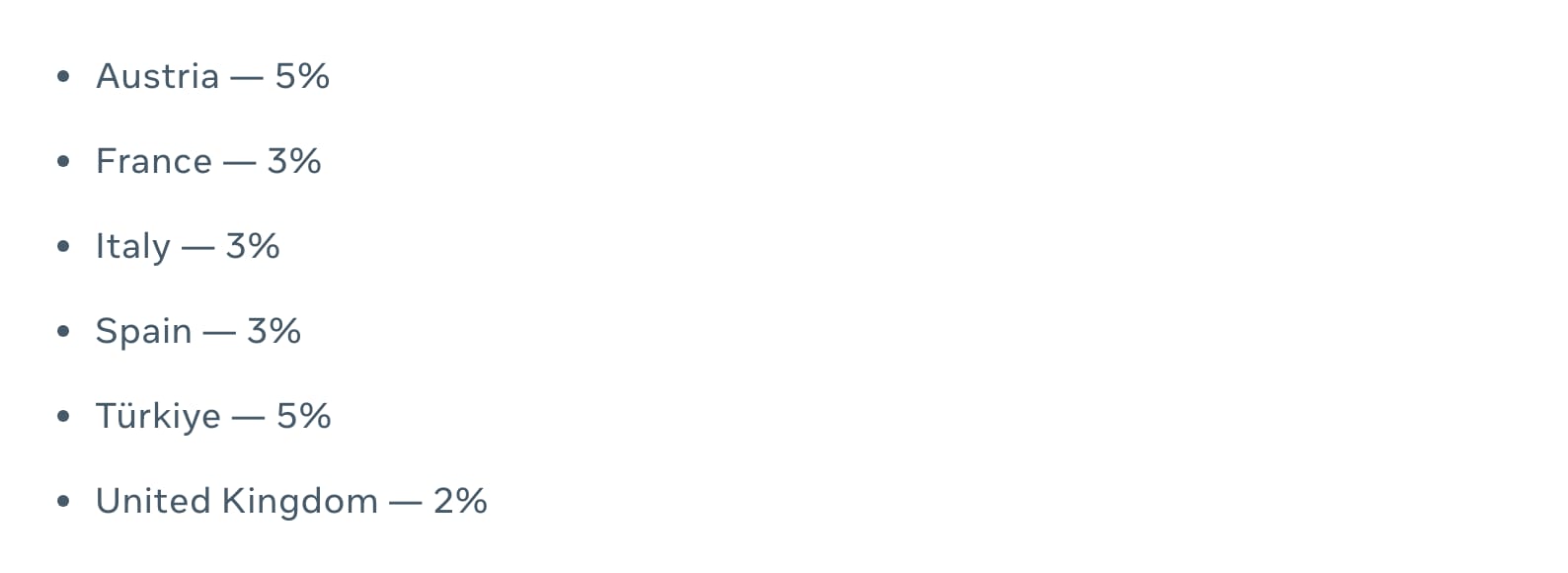
- Fees for some countries. If your ads are shown in Austria or Türkiye (5%), France, Italy or Spain (3%), or the UK (2%), Meta adds a fee on top of your budget. You won't see it in Ads Manager, only on the invoice.
- Taxes. Sales tax or VAT is added on top as well, depending on your country.
So when you plan your month, count on a bit more than budget times 30. None of this is hidden, but it's spread over five different help pages.
How to pay less for Facebook ads
You can't negotiate with an auction. But three things are in your hands.
Work on your creatives. Meta says it plainly: ads that are more relevant cost less. Test several creatives, and keep the ones with the lowest cost per result.
Don't target too narrow. Meta's pricing page says ad sets with an audience of at least 2 million people often perform better. If yours is a few thousand people, widen the location or the interests.
Stop touching your campaigns. A big edit (new audience, new creative, a pause of a week or more) sends the ad set back to learning, with the higher costs that come with it. Same for the budget: Meta's own example is that going from $100 to $101 changes nothing, and going from $100 to $1,000 starts the learning again. Make your changes in one go, then leave it alone while it learns.
Further reading: Why your Facebook CPM is high
Are Facebook ads worth it?
They're worth it when a customer brings in more than it costs to get one.
Say you make $150 on each sale. At $118 per purchase, you keep $32. Good.
Now say your ads perform like the expensive quarter of advertisers, at $254 per purchase. You lose $104 on every sale.
Same product, same platform. So before you spend anything, do the math with a bad scenario, not just the average one. The ROAS calculator (return on ad spend) and the ads profit calculator will do it for you.
Where these numbers come from
They're reported by advertisers on AdKit: 800+ ad accounts running Meta ads (Facebook and Instagram) in September 2026, 280+ of them in the United States, from small businesses to agencies running ads for clients. Each account counts once, whatever it spends, and nothing is shown with fewer than 10 advertisers behind it.
Facebook and Instagram are counted together, since you buy both in the same place (Meta Ads Manager). A cost per lead or per purchase is an advertiser's spend for the month divided by its leads or purchases.
The benchmarks page has every number by country, industry, campaign goal and month, and it's updated daily.
Final thoughts
These numbers tell you what's normal. They can't tell you what you'll pay, because no row here has your product, your audience and your ads in it.
After a month of running ads, your own account is the better source. And inside AdKit, the benchmarks show how your CPM, cost per click and click-through rate (the share of people who click after seeing your ad) compare with advertisers like you, so you know whether a $1.50 click is a problem or just the United States.
Frequently asked questions
Whatever you let Meta spend. There is no monthly price: you set a daily budget and Meta can spend up to 7 times it in a week. A budget that buys 50 leads a week at the US median of $37 a lead comes to about $7,950 a month.
In September 2026 the median CPM (cost per 1,000 impressions) was $22.75 in the United States and $9.31 worldwide, across 800+ advertisers on AdKit. Half of US advertisers paid between $13.59 and $41.34.
Whatever daily budget you set. Meta publishes no daily minimum in dollars: its help page only says minimum budgets vary by country and campaign goal. On a given day Meta can spend up to 75% more than the daily budget you typed in.
Meta publishes no price for a boosted post. The only figure on its pricing page is to start with at least $5 over six days. What that buys depends on who sees it: 1,000 impressions cost about $23 in the United States and $9 worldwide.
One that is lower than what the result brings in. For reference, in September 2026 the median cost per lead was $36.69 in the United States ($24.46 worldwide), and the median cost per purchase $118.39 ($49.13 worldwide).
For traffic, yes: at the US median of $0.90 a click it buys about 550 clicks. For purchases, no: at the US median of $118 a purchase it buys about 4, far from the roughly 50 results a week Meta says its system needs. In that case Meta advises optimizing for a more frequent result, such as add to cart.
Two reasons. A charge of a dollar or two is usually Meta checking your card, and it disappears within a few days. Repeated charges of the same amount are payment thresholds: Meta charges your card every time your spend reaches a set amount, so one ad can produce several charges a month.
Yes, it is the same thing. Meta ads is the name for the ads you buy in Meta Ads Manager, which run on Facebook and Instagram. The numbers on this page count both together.
A cheaper click is not a cheaper customer. On Google someone typed what they want; on Facebook someone was scrolling. Compare cost per lead or cost per purchase between the two, never cost per click.