

[ Our verdict ]
The best MCP for Meta Ads is AdKit. It is the safest option, since every change your agent makes is saved as a draft you approve before it goes live, and the most complete, with a competitive ad library, AI creatives, and a strategy skill on top of campaign management. It runs seven ad platforms from one connection (Meta, Google, TikTok, Reddit, X, LinkedIn, and Microsoft) and is a reviewed Meta Tech Partner. Below we rank 20 Meta Ads MCP servers by what they can do, how easy they are to set up, safety, trust, and price.
[ Quick picks ]
Best overall
AdKit
Draft-safe, full toolkit, reviewed Meta partner
Best official option
Meta Official MCP
First-party, but in beta with no draft or safety step
Best for reporting only
Triple Whale
Read-only analytics, cannot run or change ads
An MCP server is what lets an AI agent actually touch your Meta ad account. Without one, your agent can talk about your campaigns but cannot read a report or change a budget. With one, it can pull performance, draft new campaigns, and launch ads, all from the chat window you already use.
The problem is that "Meta Ads MCP" now means very different things. Some servers can only read your data. Some can spend real money the second your agent decides to. Some take an hour and a terminal to set up. We sorted through them so you can pick the right one in a few minutes.
What is the best MCP for Meta Ads?
For most advertisers, AdKit is the best Meta Ads MCP. Five reasons:
- It is safe by default. Every change your agent makes is saved as a draft. Nothing goes live until you approve it, so an agent cannot quietly burn your budget. Most other servers write straight to your live account.
- It does more than call the API. Beyond creating and reading ads, it gives your agent a competitive ad library, AI creative generation, a swipe file, and a strategy skill. The other servers stop at the raw API.
- It runs your core channels from one connection. Meta, Google, TikTok, Reddit, X, LinkedIn, and Microsoft, with Pinterest and Snapchat coming, so one agent covers your whole media mix without you wiring up separate servers.
- It is official, quick, and uncapped. AdKit is a reviewed Meta Tech Partner using the official Marketing API, setup is hosted in about three clicks with no tokens or code, and there are no daily request caps.
- Pricing is flat. $29 a month for one brand, $49 for unlimited brands, every tool included. Nearly every paid rival meters you instead: per ad account (Pipeboard), per task (Adspirer), per API call (Zuckerbot), a percentage of your ad spend (Synter), or per-operation caps (Blend).
If you only ever touch Meta and want a first-party option, Meta's own official MCP is the natural second choice. If you only need reporting, read-only tools like Funnel.io and Triple Whale pull your Meta data into any AI client without touching campaigns. The rest of this list covers where each tool fits and where it falls short.
How we ranked Meta Ads MCPs
We scored each server out of 100, across the five things that decide whether it is useful, weighting each by how much it matters in daily use:
- Features (30 points): how much it does for running ads. How many platforms it covers, whether it can create and launch campaigns or only read, and how far it goes past the raw API into things like audience tools, creative help, and competitive research.
- Ease of setup (25 points): can you connect in a few clicks from a hosted tool, or do you need a terminal, your own API credentials, and a deploy step before anything works?
- Safety (20 points): is there a human approval step before a change spends real money, or does a write go straight to your live account?
- Trust (15 points): is it an official, reviewed Meta partner on the sanctioned Marketing API, and a maintained product rather than a weekend repo? We also check the customer proof on each vendor's homepage: do the named reviewers exist on the platforms whose logos they carry? If not, the card says so.
- Pricing (10 points): a flat monthly fee, or per-call and percentage-of-spend charges that grow as you scale?
We also note how each one is hosted, fully hosted for you, self-hosted on your own infrastructure, or run locally in a terminal, because that decides how much work setup really is. Where a tool does not make something clear, we flag it rather than guess.
Full disclosure: AdKit is our product. We still built this list the way we would want to read one. Every server is scored on the same five criteria, we call out where rivals beat us, and you can check our reasoning on each card below.
The 20 best Meta Ads MCP servers
AdKit
Best overall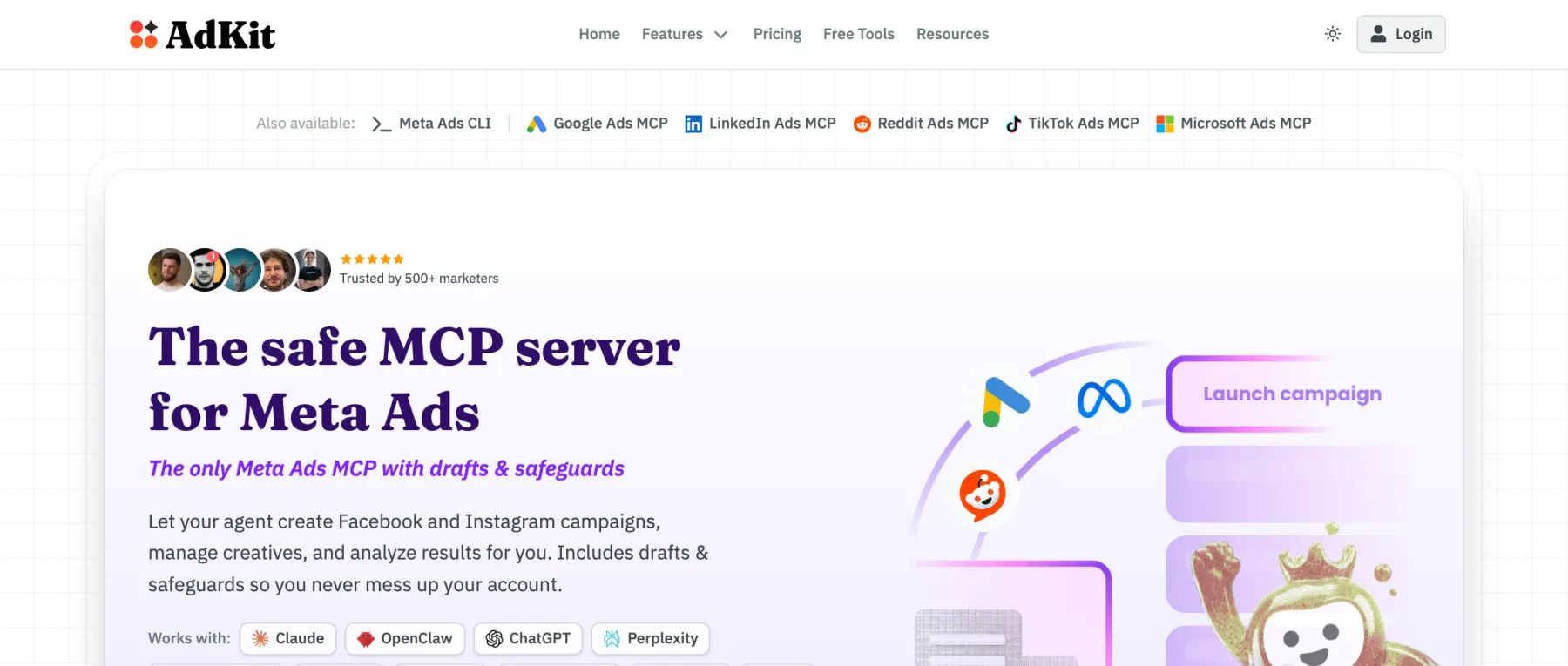
AdKit's Meta Ads MCP page. Every change your agent makes is saved as a draft first.
- Features28/30
- Setup24/25
- Safety20/20
- Trust15/15
- Price9/10
AdKit is a hosted MCP server built for running ads, not a generic connector. It talks to Meta through the official Marketing API, and every campaign, ad set, ad, and creative your agent touches is saved as a draft you approve before it goes live. You can loosen that once you trust it; the default protects your budget.
It pairs that safety with the deepest toolkit here: a library of 500,000+ real ads, AI creatives, a swipe file, and a free Meta Ads strategy skill. One connection covers Meta, Google, TikTok, Reddit, X, LinkedIn, and Microsoft. AdKit is a reviewed Meta Tech Partner, setup is three clicks with no tokens or terminal, there are no daily request caps, and it works with Claude, ChatGPT, Cursor, and any MCP client.
Pros
- ✓Draft-first, so nothing goes live until you approve it
- ✓Built-in competitive ad library, AI creatives, and a strategy skill
- ✓Runs seven ad platforms from one connection (Meta, Google, TikTok, Reddit, X, LinkedIn, Microsoft)
- ✓Reviewed Meta Tech Partner, hosted setup in about three clicks
Cons
- –Paid from the start, after a 7-day free trial
- –Newer brand than Meta's own first-party option
Hosting
Fully hosted
Safety
Draft-first approval
Trust
Reviewed Tech Partner
Price
$29-$49/mo flat
Meta Official MCP
Best official option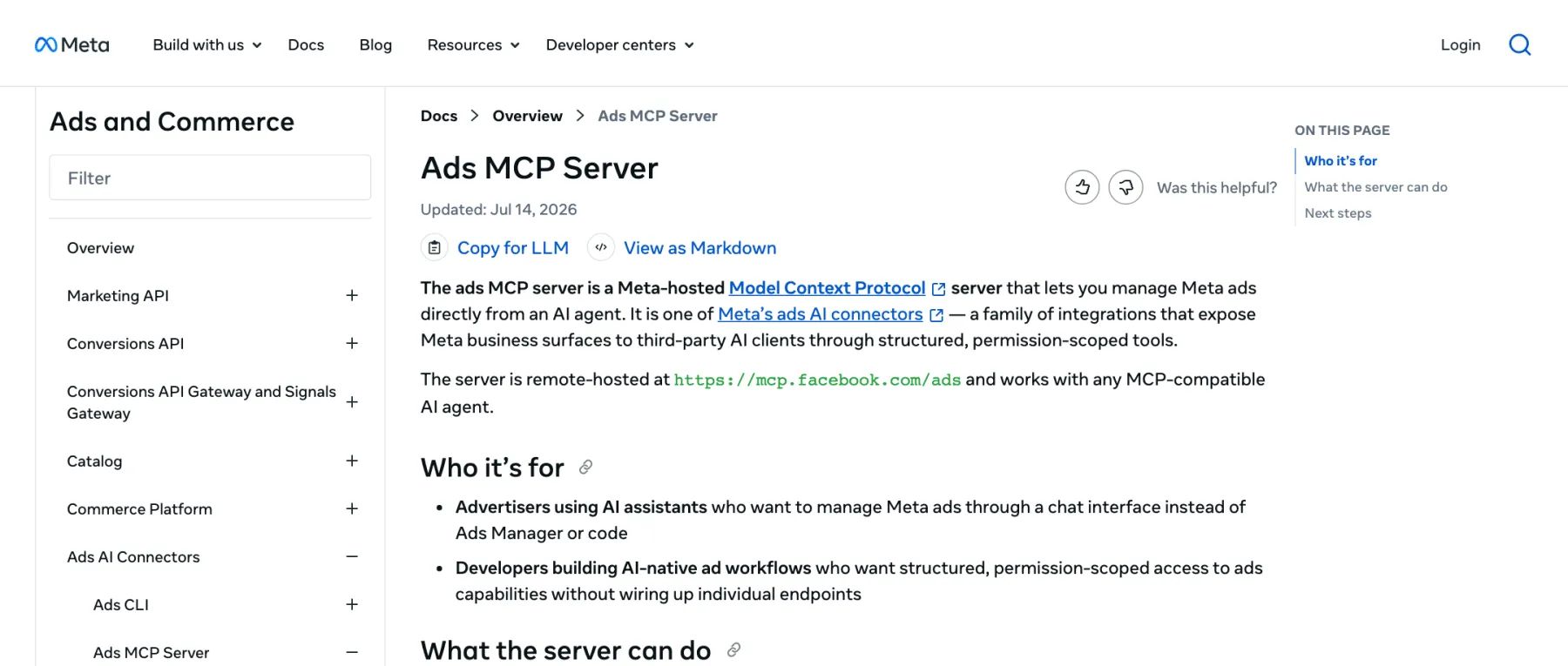
Meta's own Ads MCP Server documentation on the Meta for Developers site.
- Features22/30
- Setup23/25
- Safety8/20
- Trust15/15
- Price10/10
In 2026 Meta shipped its own Meta-hosted MCP server, plus a CLI. It creates and edits campaigns, ad sets, and ads through natural language, pulls reports, and builds product catalogs, with no developer credentials or coding required. The most direct line to the Marketing API you can get.
The limit is in the name: Meta only, and account management only, with no research or creative tools. It is free for eligible advertisers in open beta within a daily request limit, and there is no draft or approval step, so changes apply straight to your live account. Official and promising, but narrow.
Pros
- ✓First-party, straight from Meta
- ✓No developer credentials or coding required
- ✓Free for eligible advertisers in beta
Cons
- –Meta only, nothing for Google or TikTok
- –No draft step, changes hit your live account
- –Daily request cap, and open-beta rough edges
- –Account management only, no research or creative
Hosting
Hosted by Meta
Safety
No draft step
Trust
First-party (Meta)
Price
Free, daily cap
Adspirer
Paused-default writes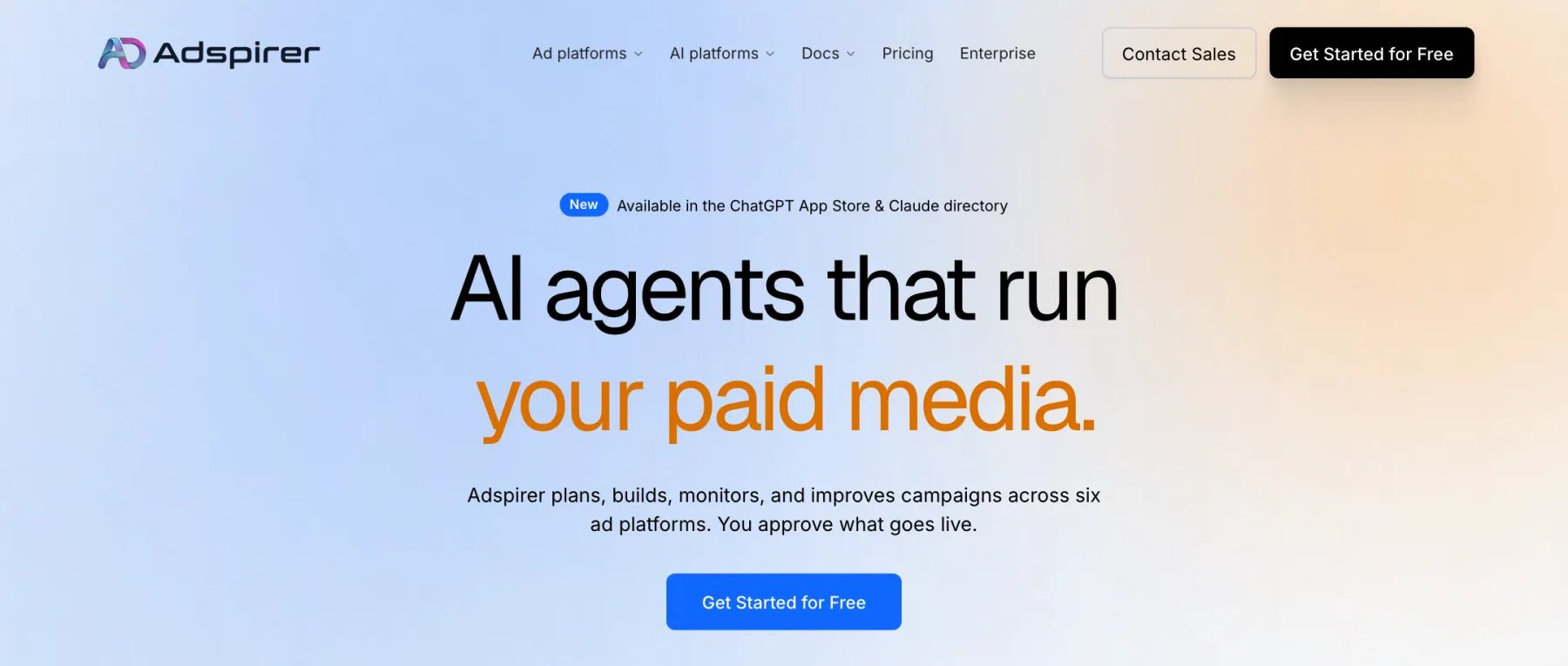
Adspirer's homepage. Six ad platforms, with an approval step before anything goes live.
- Features21/30
- Setup19/25
- Safety14/20
- Trust6/15
- Price6/10
Adspirer is a hosted MCP with 178+ tools across Meta, Google, LinkedIn, and TikTok. LinkedIn Ads with 45 dedicated tools is rare in this set, the free tier needs no card, and new campaigns are created paused by default.
The catch is metering. Adspirer charges per task: the Plus plan gives you 150 a month, and one campaign launch can burn 20 to 50, so active testing climbs the tiers quickly. No dashboard, ad library, competitor research, or creative generation. A clean API wrapper with good coverage that stops at the API.
Pros
- ✓178+ tools across 4 platforms; rare LinkedIn Ads support (45 tools)
- ✓Free tier, no card required
- ✓Simple, focused; no bloat
Cons
- –Tool-call metering burns fast (a launch = 20-50 calls; Plus plan = 3-7 launches/mo)
- –No dashboard, everything via the AI client
- –Edits to existing campaigns go live with no gate
- –No ad library, research, or creative
Hosting
Hosted (Streamable HTTP)
Safety
New paused, live edits
Trust
Bootstrapped, no badge
Price
Free, then $40-$167/mo
Synter
Most platforms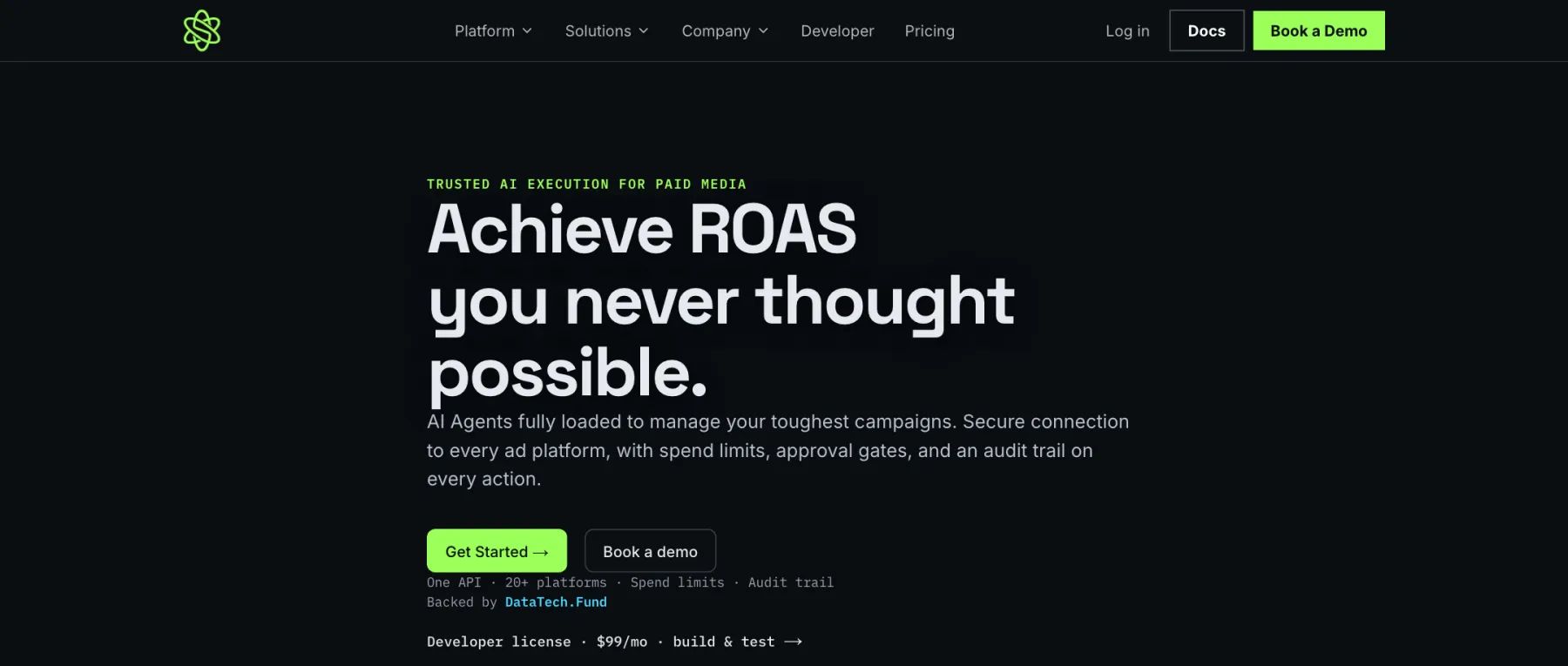
Synter's homepage. Spend limits, approval gates, and an audit trail across 27 platforms.
- Features24/30
- Setup17/25
- Safety15/20
- Trust6/15
- Price2/10
Synter has the widest platform coverage of any ad MCP here: 27 channels including Meta, Google, TikTok, LinkedIn, Amazon, Pinterest, Walmart Connect, and Instacart, more than AdKit. It is MIT open-source, runs hosted or as a CLI, and its tiered autonomy auto-executes low-risk actions while routing high-impact ones for approval.
For anyone living in Meta, the counterpoint: it emerged from stealth in March 2026, its per-platform tooling is templated and shallow, and there is no ad library, competitor tracking, or swipe file. Paid plans start at $20 a month plus a fixed 3% of managed spend and per-action fees. Breadth is its argument; Meta depth and draft safety are AdKit's.
Pros
- ✓Broadest platform coverage of any ad MCP (27), including niche channels like Walmart Connect and Instacart
- ✓Tiered per-action approval with budget guardrails
- ✓MIT open-source with hosted and local transport
- ✓AI image and video generation on paid tiers
Cons
- –Launched March 2026 with little independent validation
- –Credit-metered; free tier is read-only only
- –No Meta ad library or competitor research
- –Per-platform depth is thin
Hosting
Hosted + CLI (OSS)
Safety
Tiered approval
Trust
VC-backed, 2026 launch
Price
Free (read-only), then $20-$500/mo + 3% of spend
Pipeboard
Raw API access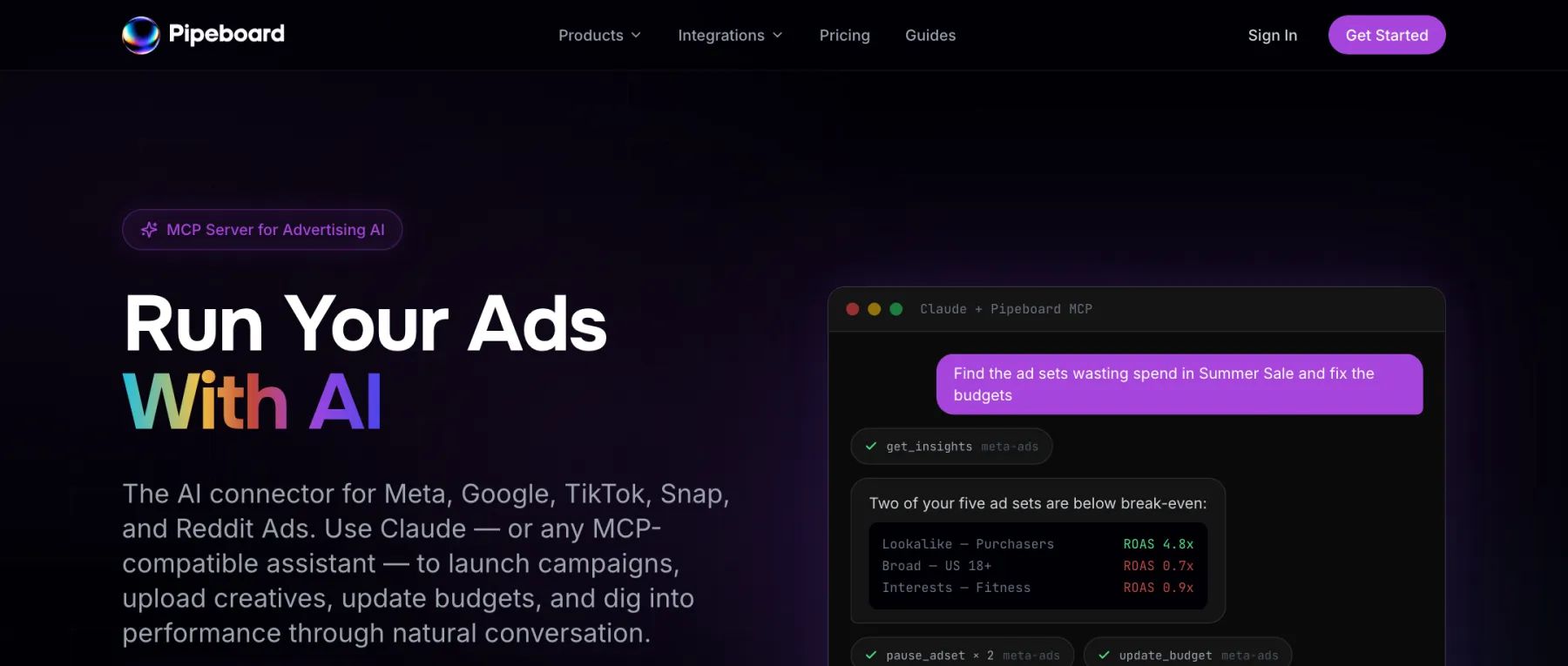
Pipeboard's homepage, showing its Claude integration for Meta, Google, TikTok, Snap, and Reddit.
- Features19/30
- Setup15/25
- Safety11/20
- Trust6/15
- Price5/10
Pipeboard is the developer's pick. It wraps Meta, Google, TikTok, and Snap in 120+ tools that expose every API parameter, the most flexible raw access here. New campaigns are created paused, and it plugs into n8n, Cursor, and custom Python. Founded in August 2025 by an ex-Google SRE.
It is built for engineers: you work with raw Meta API objects, edits to live campaigns execute with no gate, and there is no ad library, research, or creative tooling. The free tier caps you at 30 executions a week, and paid plans are priced per ad account, $29.90 for three, $99 for ten, $199 for 25, so an agency with 25 clients pays $199 a month against AdKit's $49 for unlimited brands.
Pros
- ✓Open-source with full API passthrough; 120+ tools, every Meta/Google/TikTok parameter exposed
- ✓Works natively in n8n, Cursor, and custom Python workflows
- ✓Free tier, no credit card required
Cons
- –Priced per ad account, 3 accounts at $29.90, 10 at $99, 25 at $199
- –Raw API objects only; you need to know Meta's API structure
- –No UI or visual review before publish
- –No ad library, research, or creative
Hosting
Hosted + CLI (OSS)
Safety
Paused-default, live edits
Trust
Bootstrapped, OSS
Price
Free; $29.90 (3 accounts) to $199 (25)
Blend MCP
Ecommerce-leaning writes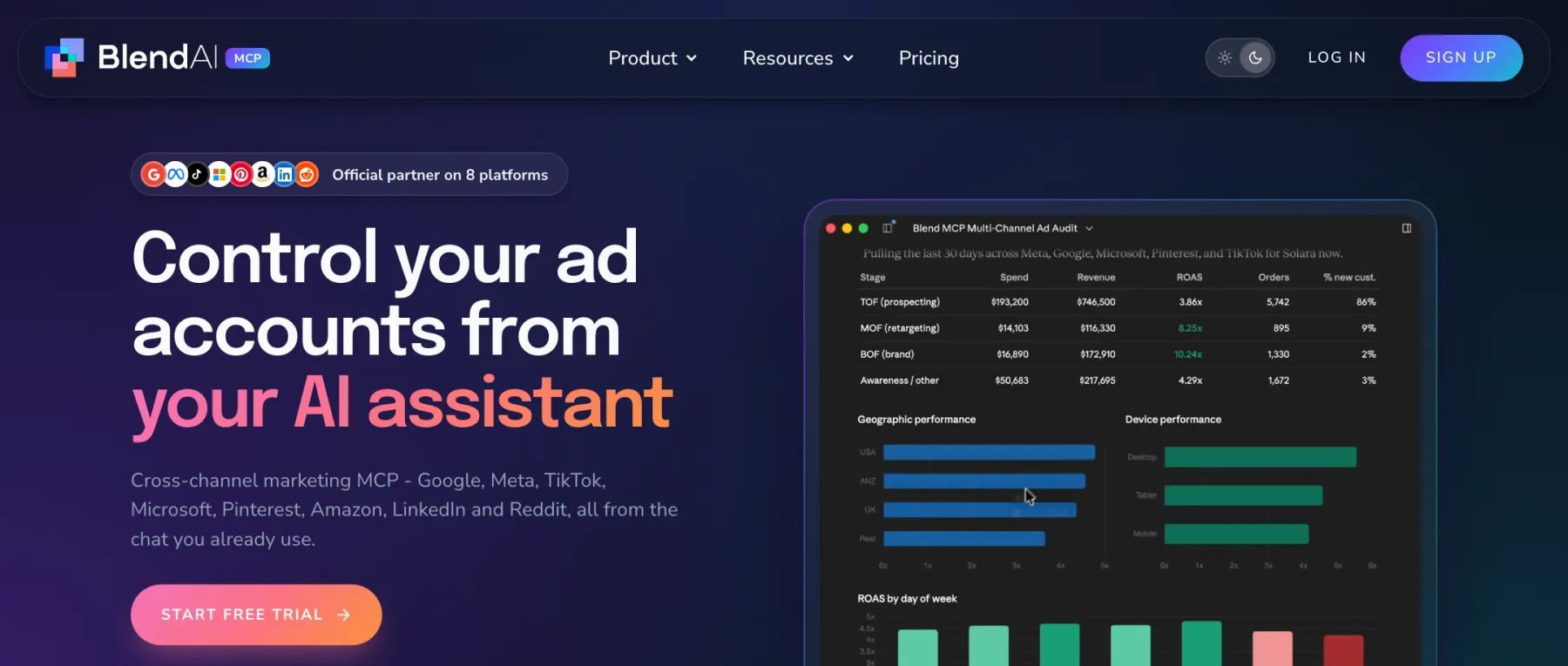
Blend MCP's homepage. Cross-channel ad management across eight platforms.
- Features19/30
- Setup18/25
- Safety3/20
- Trust8/15
- Price7/10
Blend is the strongest pick for ecommerce brands on Shopify or WooCommerce. It pulls your product catalog natively, so your agent builds campaigns from live inventory, and it covers Meta, Google, TikTok, Microsoft, and Pinterest. At $29 a month it is the lowest entry price among the purpose-built ad MCPs here, from a company founded in 2020 with $3.6M raised.
The caveats: every tier has an operations cap (500/2,500/10,000 a month) that an active agent burns through quickly, and actions execute on live accounts with no draft or approval step. Built for ecommerce in that stack; for everyone else, the missing draft layer is the thing to weigh.
Pros
- ✓Native Shopify and WooCommerce product catalog integration
- ✓Covers Microsoft Ads and Pinterest, rare in this set
- ✓Founded 2020 with $3.6M raised; the most established purpose-built ad MCP here
Cons
- –Operation caps on every tier; hit fast with an active agent
- –Explicitly built for ecommerce; other use cases are second-class
- –Actions execute live with no draft step
- –No competitor tracking, ad library, or full creative
Hosting
Hosted
Safety
Live execution, no draft
Trust
Founded 2020, $3.6M
Price
$29-$199/mo (ops cap)
Zuckerbot
Meta-only open-source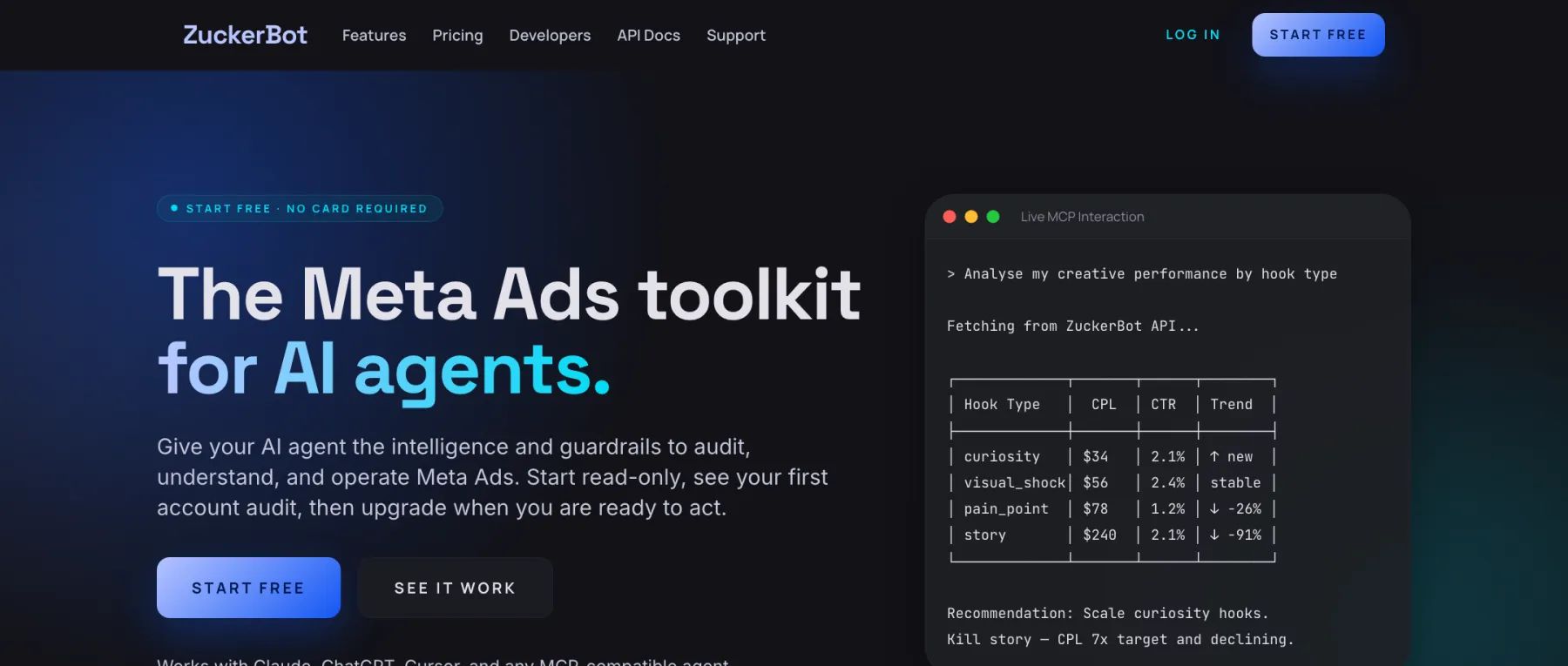
ZuckerBot's homepage. Read-only to start, with an upgrade path to write access.
- Features14/30
- Setup9/25
- Safety13/20
- Trust12/15
- Price6/10
Zuckerbot is an open-source (MIT) CLI and MCP server for Meta Ads and an approved Meta partner, with 50 tools covering campaigns, audiences, creatives, and conversion tracking. It has an approval step before a campaign goes live, and the free tier is read-only, so you can explore safely. The most credible of the open-source servers here.
It is Meta only, installed from the terminal with an API key. Pricing is metered by API calls: Pro is $49 a month for 50,000, Scale $149 for 500,000, with overage per extra thousand; the earlier percentage-of-spend fee is gone. Choose it if you specifically want open-source code you can self-host. On coverage, setup, and the toolkit around it, AdKit is ahead even if Meta is your only channel.
Pros
- ✓Open-source (MIT) and an approved Meta partner
- ✓Has an approval step before a campaign goes live
- ✓Some research and creative tools included
Cons
- –Meta only, nothing for Google or TikTok
- –Terminal install with an API key, not for non-developers
- –Metered by API calls, with overage fees past your plan's allowance
Hosting
Self-host / terminal
Safety
Approval step
Trust
Approved Meta partner
Price
Free, then $49-$149/mo + overage
Ryze AI
Customer proof unverified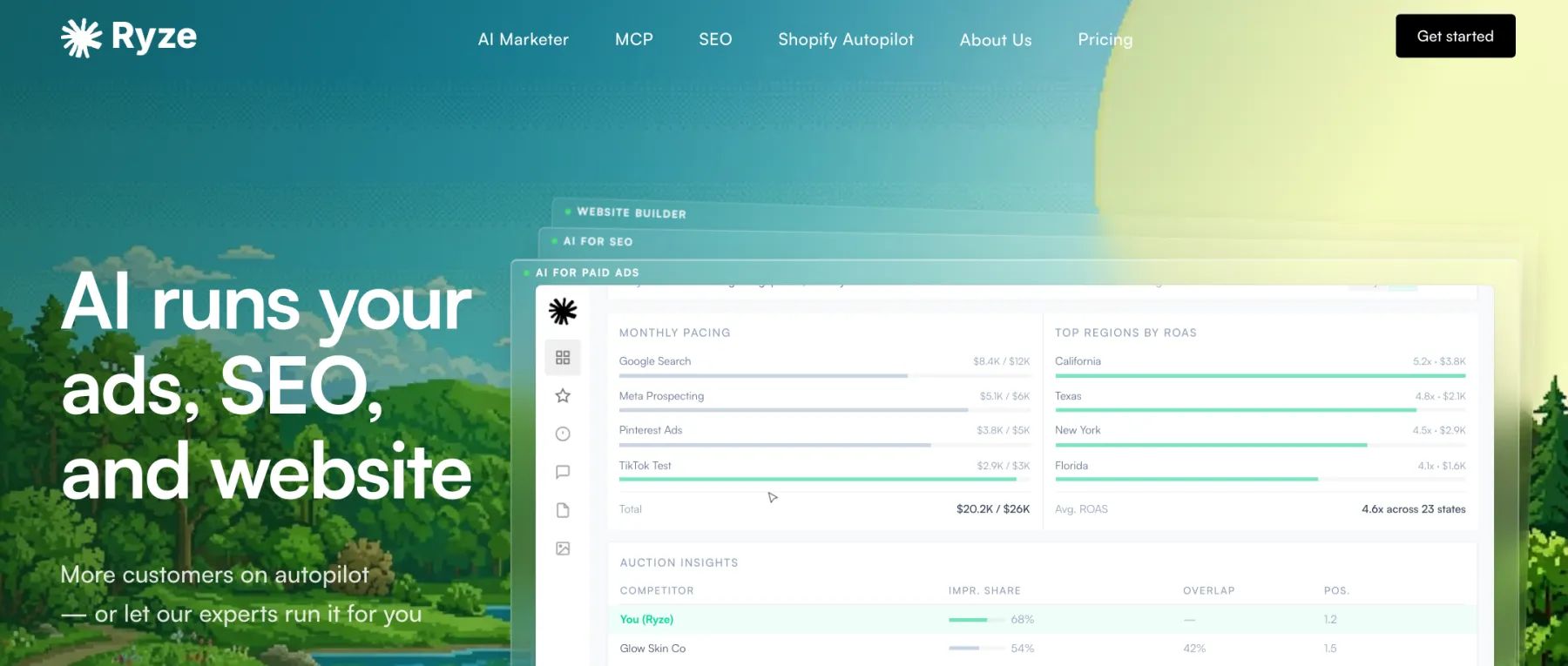
Ryze AI's homepage. Ads, SEO, and website automation in one product.
- Features18/30
- Setup17/25
- Safety9/20
- Trust2/15
- Price1/10
Ryze is an optimization engine first and an MCP second. It runs 24/7 on your existing campaigns, adjusting bids and budgets between your agent sessions, and its Meta and Google MCP writes go through a per-action approval gate. If you want continuous optimization rather than create-and-launch, that is its distinct value.
The catches: credit pricing is opaque and every plan caps you by ad spend (the entry plan at $25k a month), TikTok and LinkedIn are marketing claims the MCP page does not confirm, and "Schedule mode" removes the approval gate and runs live. No creative or research tools.
Trust is where it fails our check. On 6 September 2026 we could not verify any of the six testimonials on its homepage:
- The tweet-styled review credits @gabri_isleia. That X account does not exist (404).
- The Trustpilot-badged review names "Daniel Roser, GB, 7 reviews". Trustpilot's page for get-ryze.ai lists another business name and 50 reviews, none by him.
- "Mathilde Biggs, CEO MotifDigital Agence" and the company "Rivert" have no trace online, and the same five names carry different titles and companies on Ryze's own checkout page.
None of the platform logos link anywhere. Treat its testimonials and performance claims as unverified until it publishes proof you can follow to a source.
Pros
- ✓24/7 autonomous optimization engine, unique in this set
- ✓Meta and Google MCP write with a per-action approval gate
- ✓Optional managed service with a human strategist
Cons
- –Homepage testimonials could not be verified, see the trust note below
- –TikTok and LinkedIn MCP support is unconfirmed; treat it as Meta and Google only
- –Credit pricing is opaque and capped by ad spend
- –Schedule mode writes to live accounts with no approval
- –No ad library, research, or creative
Hosting
Hosted
Safety
Per-action approval (autonomy mode)
Trust
Customer proof unverified
Price
~$43-$89/mo + credits
Windsor.ai
Most data sources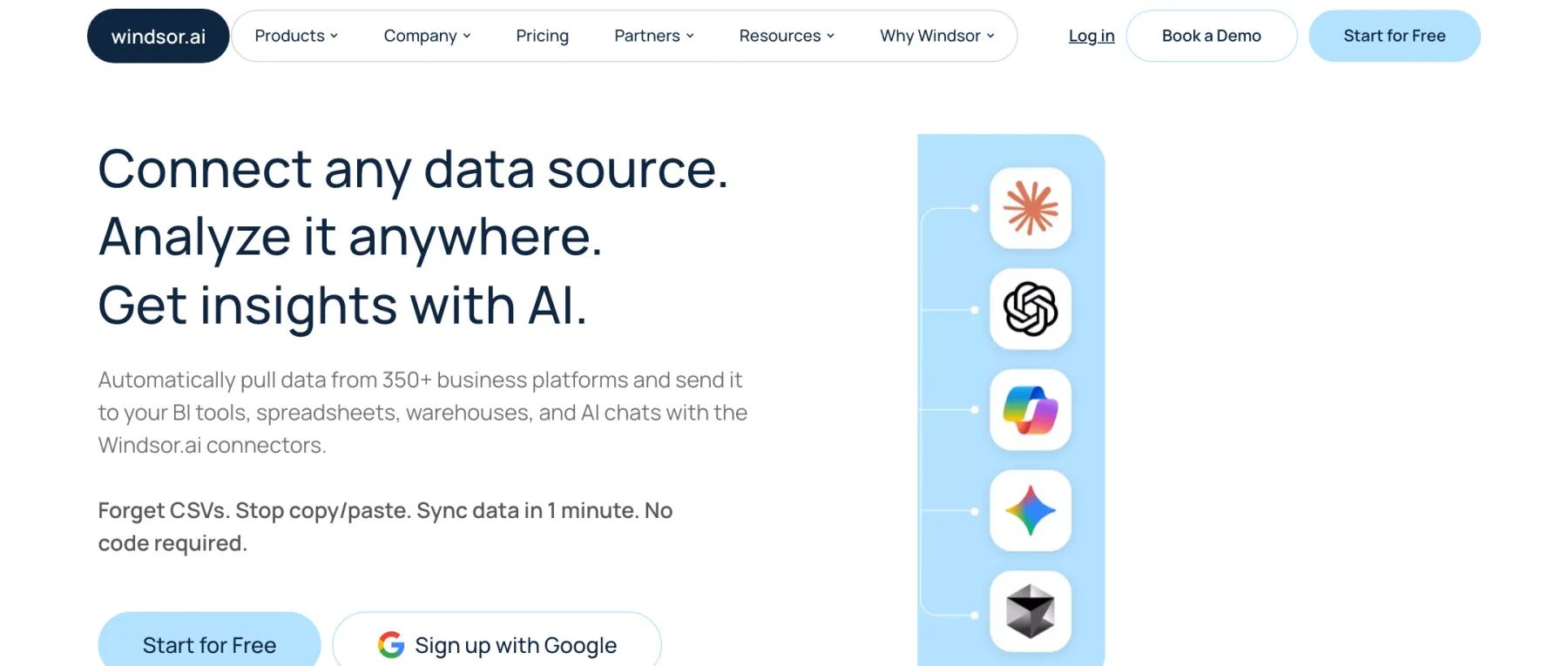
Windsor.ai's homepage. 350+ data connectors feeding BI tools and AI clients.
- Features12/30
- Setup17/25
- Safety2/20
- Trust10/15
- Price2/10
Windsor.ai connects 325+ marketing sources to BI tools and warehouses, and its MCP is reporting-first. Founded in 2017 and acquired by team.blue in January 2026, it is the most mature company in this list, with SOC 2 Type II, GDPR compliance, and 17,000+ businesses.
It recently added Meta writes in Claude, ChatGPT, and Copilot: pause, enable, create, edit, set budgets, boost a post. There is no approval step in front of them, the toolset stays shallow next to a management server, and row overage billing adds cost. Strong trust posture; the core product is data integration, not campaign management.
Pros
- ✓325+ connectors; the widest data coverage here
- ✓SOC 2 Type II and GDPR; the strongest enterprise trust posture
- ✓Founded 2017 and acquired by team.blue; the most mature company here
- ✓Syncs to all major warehouses and BI tools
Cons
- –Writes only in Claude, ChatGPT, and Copilot, with no approval step in front of them
- –Shallow toolset next to a management server, not suitable as your ads tool
- –Meta is one of 325 sources, not an ads focus
- –Row overage billing and steep tier jumps
Hosting
Hosted SaaS
Safety
Basic writes, no approval step
Trust
SOC 2, est. 2017
Price
Free, then $23-$598/mo
meta-mcp (brijr)
Self-hosted on Cloudflare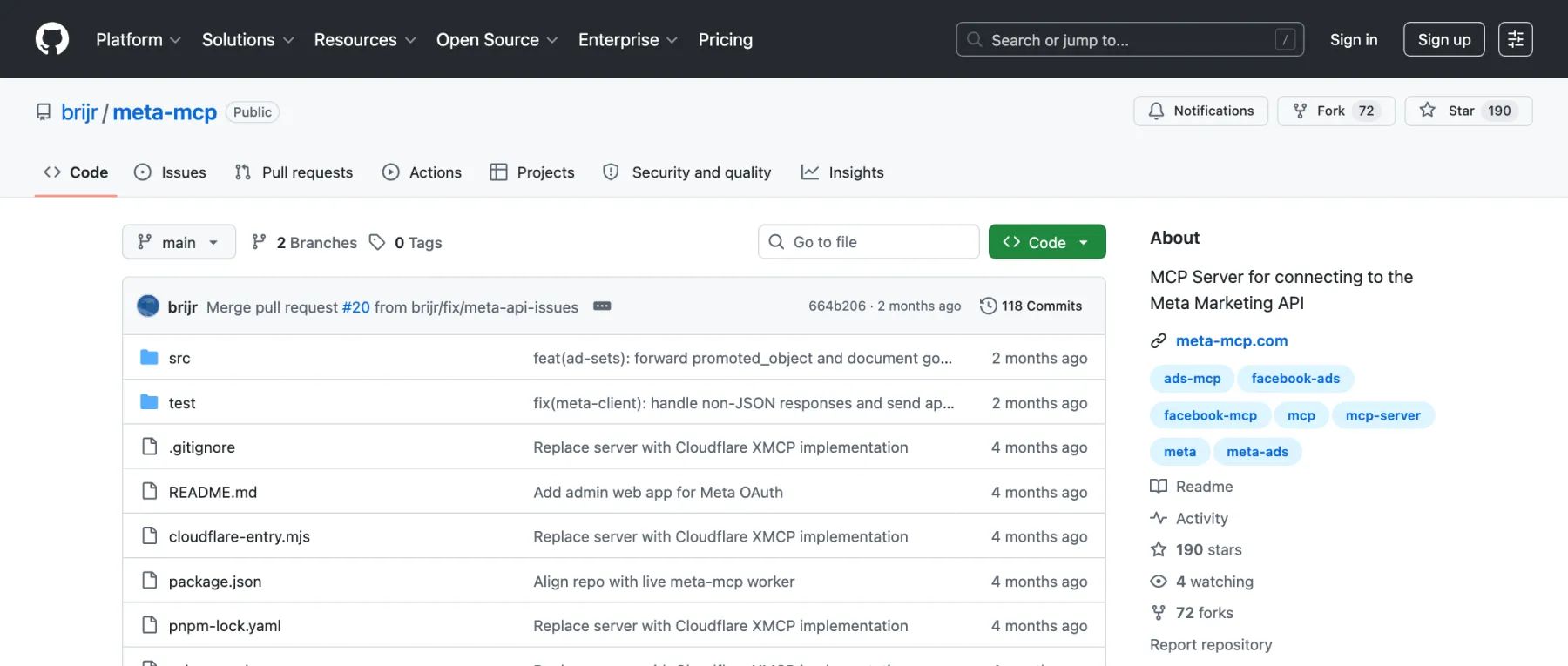
The brijr/meta-mcp repository on GitHub: 190 stars and 118 commits.
- Features17/30
- Setup8/25
- Safety2/20
- Trust5/15
- Price10/10
An open-source Meta Ads MCP (39 tools) that runs as a Cloudflare Worker in your own account: campaigns, ad sets, creatives, audiences, reporting, and batch workflows, with full write access. For a developer who wants total control and no third party in the middle, that is appealing.
It is the most do-it-yourself option here: no hosted control plane, no shared Meta app, no dashboard. You deploy it with your own Meta app credentials and maintain it yourself, and there is no approval gate. A building block for engineers, not a product for marketers.
Pros
- ✓Fully open-source, you self-host it
- ✓Total control on your own Cloudflare account
- ✓39 tools for campaigns and reporting
Cons
- –No approval gate, writes go straight to your live account
- –Meta only
- –You deploy and maintain it yourself, no dashboard
Hosting
Self-hosted (Cloudflare)
Safety
No approval gate
Trust
No partner status
Price
Free, self-hosted
mikusnuz/meta-ads-mcp
Most tools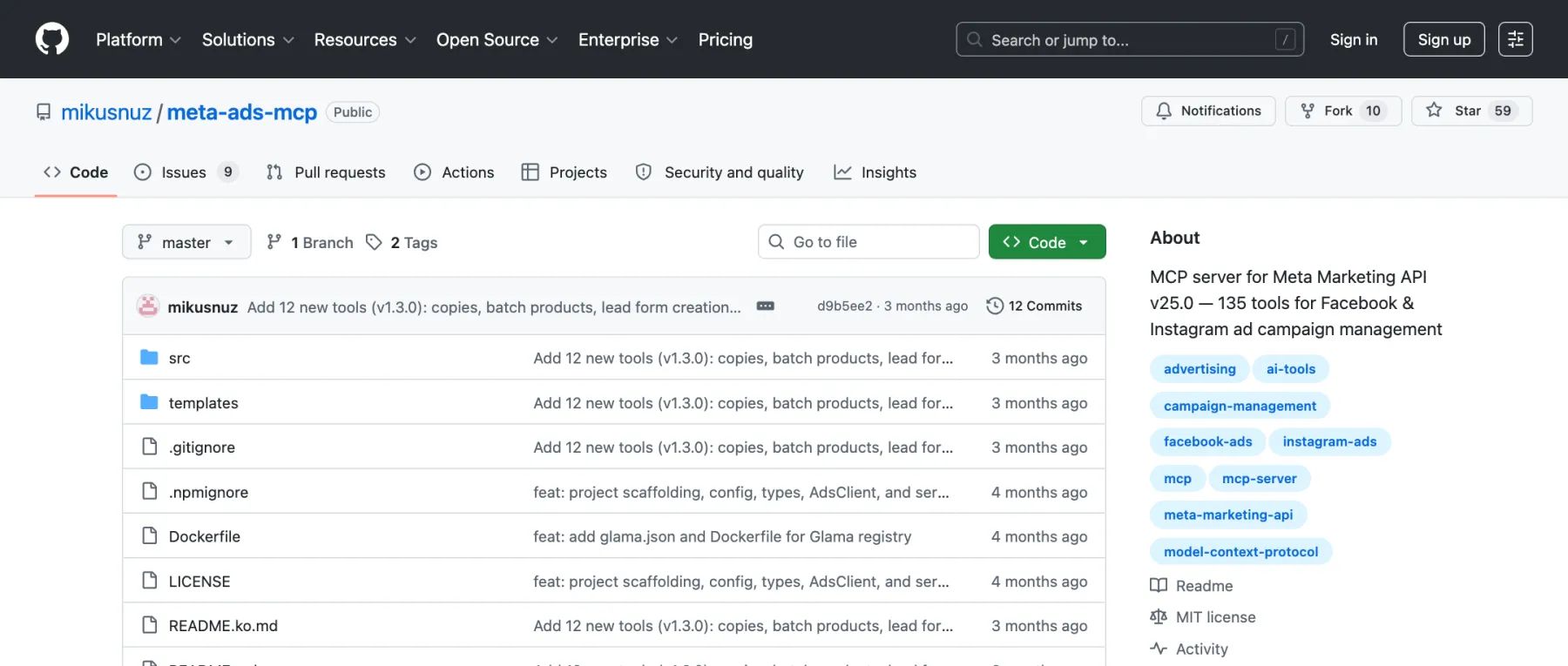
The mikusnuz/meta-ads-mcp repository on GitHub: 59 stars and 135 documented tools.
- Features17/30
- Setup7/25
- Safety2/20
- Trust3/15
- Price10/10
An open-source (MIT) server on npm with a sprawling 135 tools across campaigns, ad sets, ads, and creatives. It can create, update, pause, and delete, so on raw surface area it does a lot, and it is one of the more active small repos here.
It is a solo project with no hosted product, company, or support, and no approval or draft gate: writes go straight to the Marketing API and your live budget. Plenty of tools, none of the guardrails.
Pros
- ✓135 tools across campaigns, ad sets, ads, and creatives
- ✓Free and open-source (MIT), installable from npm
- ✓One of the more active small open-source repos here
Cons
- –No approval gate, so writes hit your live account
- –Meta only, and you self-host it
- –Solo project with no hosted product or support
Hosting
Self-hosted (npm)
Safety
No approval gate
Trust
No partner status
Price
Free, self-hosted
hashcott/meta-ads-mcp-server
Read-default small repo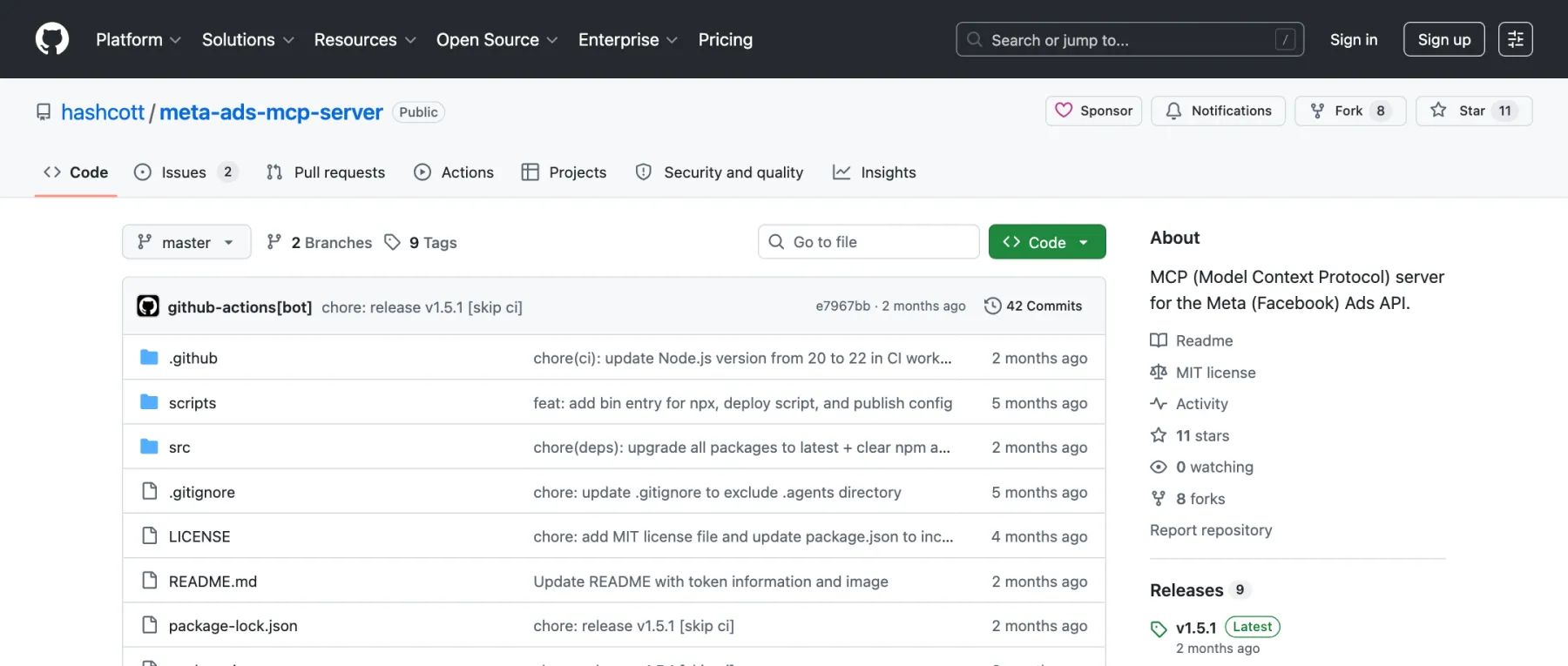
The hashcott/meta-ads-mcp-server repository on GitHub: 42 commits and 9 tagged releases.
- Features10/30
- Setup5/25
- Safety9/20
- Trust2/15
- Price10/10
An open-source (MIT) TypeScript server with 35 read tools always on and 19 write tools you enable with an environment variable. New entities default to paused. For a small repo, that is careful design: hard to spend money by accident.
The catch is everything around it: unofficial and not affiliated with Meta, a single maintainer, self-hosted with your own credentials. The most responsibly built of the obscure repos, but still a repo, not a product.
Pros
- ✓Read-only by default, with write tools you opt into
- ✓New campaigns are created paused
- ✓Open-source (MIT) with several deploy options
Cons
- –Unofficial, not affiliated with Meta
- –Meta only, and a single-maintainer project
- –You host it and manage credentials yourself
Hosting
Self-host (Node/Railway)
Safety
Paused-default, opt-in write
Trust
Unofficial, no partner status
Price
Free, self-hosted
codprocess/facebook-ads-mcp
Most minimal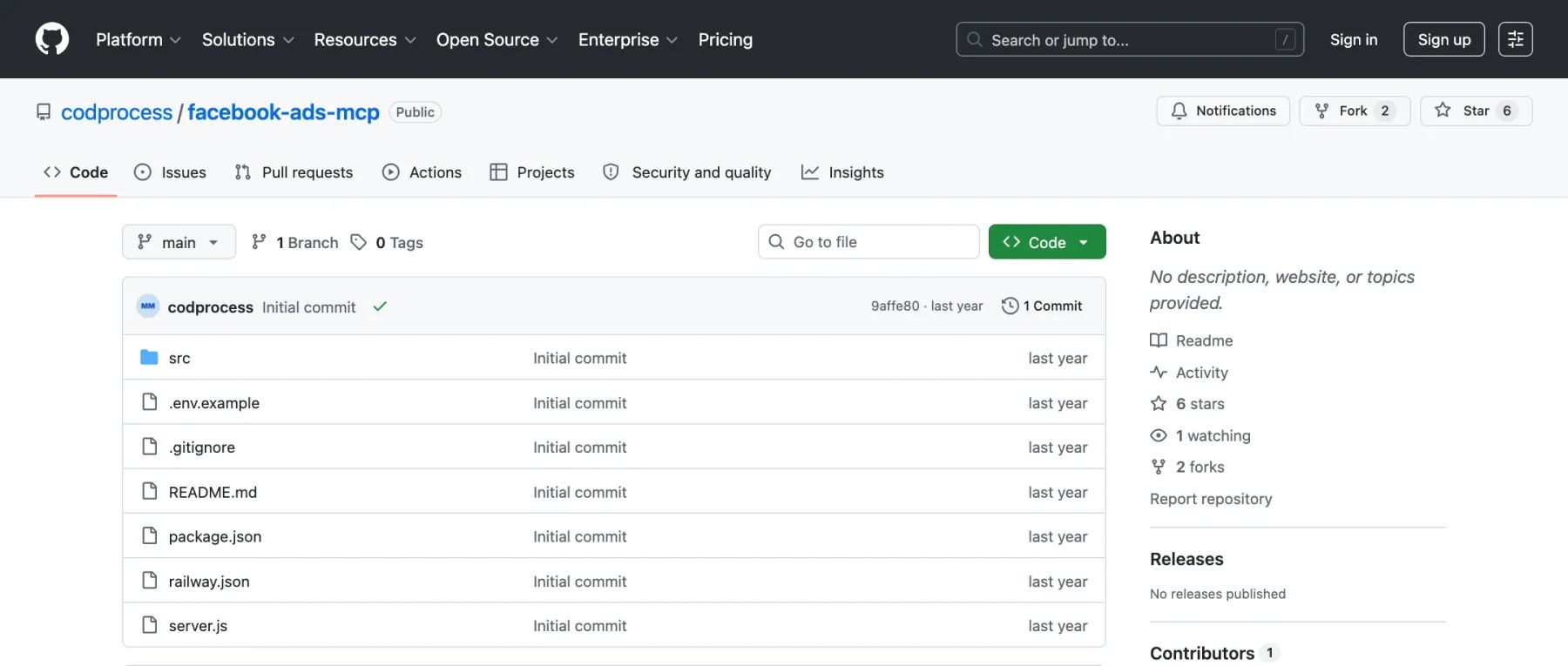
The codprocess/facebook-ads-mcp repository on GitHub, showing a single commit from last year.
- Features10/30
- Setup5/25
- Safety2/20
- Trust3/15
- Price10/10
An open-source (MIT) server that exposes Facebook Ads as REST-style endpoints with MCP framing. It can create, update, and delete campaigns, ad sets, and ads, so it covers the basics of writing to an account.
It is a starting point, not a product: a single commit on main, no approval gate, no hosted option, no real documentation. You deploy it yourself and own everything after that.
Pros
- ✓Open-source (MIT) and simple to deploy on Railway
- ✓Covers basic create, update, and delete
Cons
- –No approval gate before changes go live
- –Meta only, and you self-host it
- –A single commit, effectively unmaintained
Hosting
Self-host (Railway)
Safety
No approval gate
Trust
No partner status
Price
Free, self-hosted
attainmentlabs/meta-ads-mcp
Most lightweight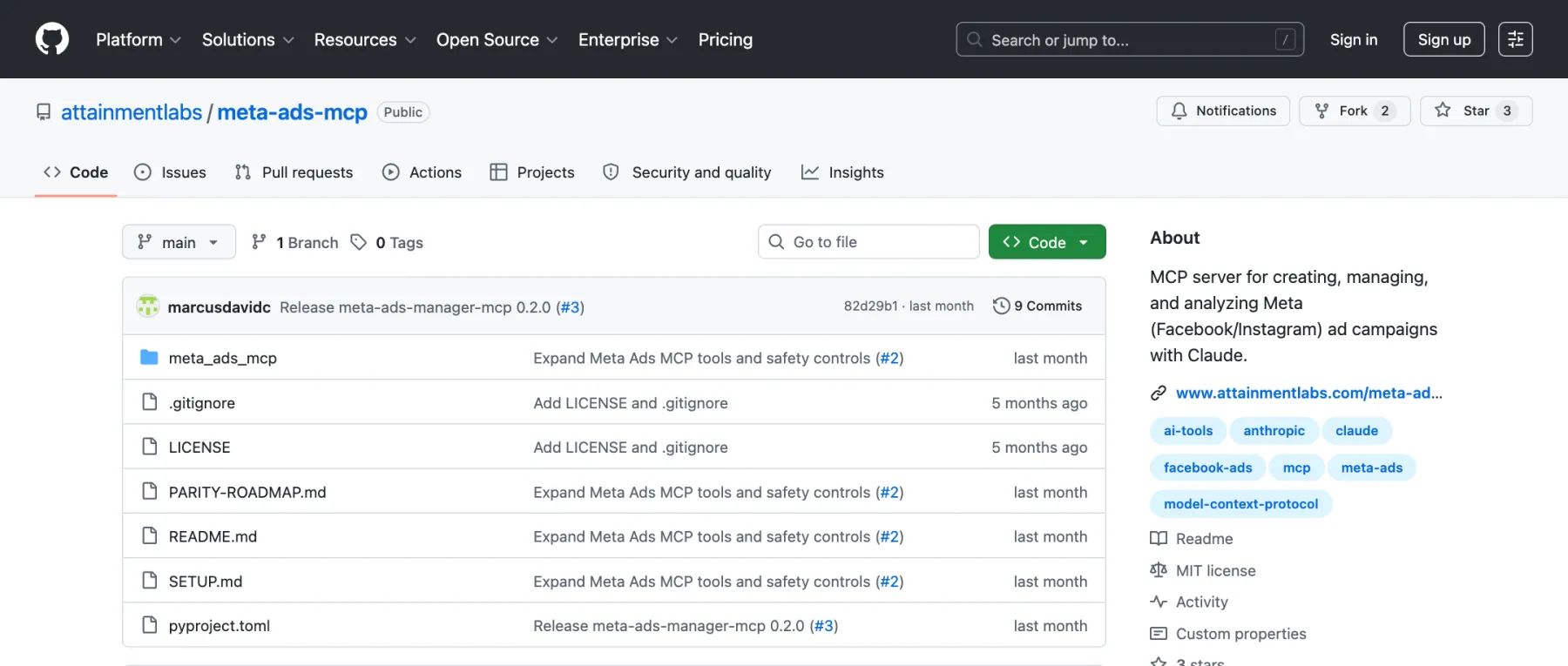
The attainmentlabs/meta-ads-mcp repository on GitHub: 9 commits, MIT licensed.
- Features5/30
- Setup4/25
- Safety8/20
- Trust1/15
- Price10/10
A small open-source (MIT) Python server with five functions: create full campaigns, then pause, activate, or delete them. Despite the size it is thoughtful about safety: new campaigns are created paused, and create defaults to a dry run.
It is unmistakably a weekend project, a handful of commits with no docs and no company behind it. Five functions is enough to demo, not to run a real account. A clean reference, not a tool for live spend.
Pros
- ✓Safe by default, with paused campaigns and dry-run create
- ✓Open-source (MIT), easy to read and run
Cons
- –Only five functions, so coverage is minimal
- –Meta only, self-hosted, and barely maintained
- –A weekend project with no docs or support
Hosting
Self-host (uvx/pip)
Safety
Dry-run + paused default
Trust
No partner status
Price
Free, self-hosted
promobase/facebook-business-mcp
Earliest stage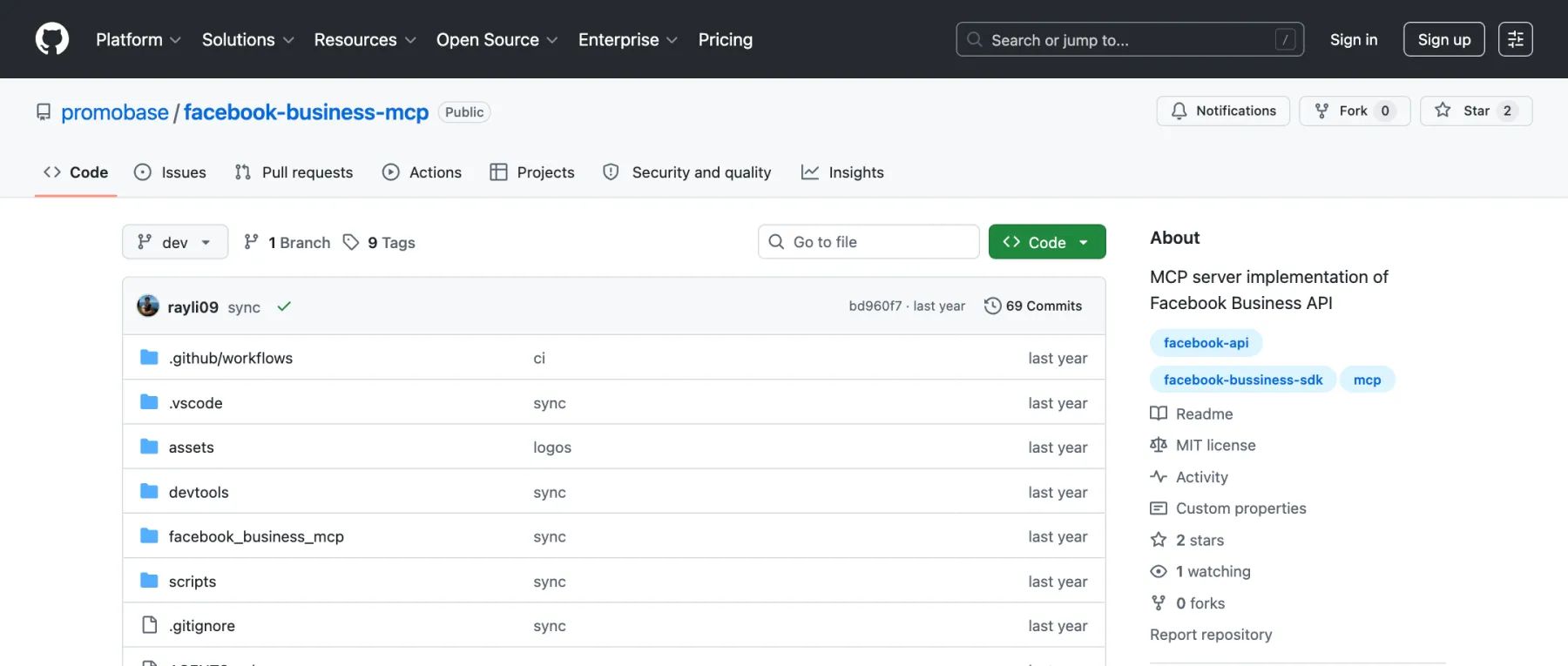
The promobase/facebook-business-mcp repository on GitHub, still tagged v0.0.9.
- Features4/30
- Setup3/25
- Safety4/20
- Trust2/15
- Price10/10
An open-source (MIT) Python server built on FastMCP that wraps the Facebook Business API, and the earliest-stage option here, still on version 0.0.9.
It is barely documented, and whether it can write to an account or only read is unclear, so we mark write support as unknown rather than guess. Something to watch, not something to run your ads on.
Pros
- ✓Open-source (MIT), built on FastMCP
- ✓Easy to run locally
Cons
- –Write support is unclear, so we mark it unknown
- –Pre-1.0 (v0.0.9), with minimal docs and no support
- –Meta only, self-hosted, and no support
Hosting
Self-host (uvx/pip)
Safety
None documented
Trust
No partner status
Price
Free, self-hosted
Composio
General connector
Composio's homepage. A general agent-tooling platform covering 1,000+ apps.
- Features8/30
- Setup5/25
- Safety2/20
- Trust4/15
- Price3/10
Composio is a hosted connector platform, closer to a Zapier for AI agents than a Meta Ads tool: Meta Ads is one toolkit on a marketplace of 1,000+ connectors. The 52-tool Meta Ads toolkit creates campaigns, ad sets, ads, and audiences and updates budgets, handy if you are wiring one agent across a CRM, a spreadsheet, and a dozen other tools.
Judged as an ads tool, it is thin: no draft or review system, and you supply your own Meta OAuth app, which has to clear Meta's app review for real write access. Fine for engineers, a wall for everyone else.
Pros
- ✓Meta sits alongside 1,000+ other app connectors
- ✓Free tier to start
Cons
- –No draft or review system, writes go straight through
- –You supply your own Meta OAuth app, which Meta must verify
- –Generic actions only, no ads features, research, or creative
Hosting
Hosted, BYO OAuth
Safety
No draft or review
Trust
No partner status
Price
Free, then $29/mo + usage
The tools below are a different breed. They are credible, widely used MCP servers that surface Meta ad data, but they are read-only: they report on your campaigns, they do not run them. We include them because you will see them mentioned, and because they sit next to a management tool like AdKit rather than replacing one.
Funnel.io
Read-only data hub
Funnel's homepage. A marketing data platform, not an ad management tool.
- Features3/30
- Setup5/25
- Safety10/20
- Trust3/15
- Price0/10
Funnel.io is an established marketing data hub, and its MCP lets Claude or Cursor read the data you have already centralized, including Meta performance pulled through one of 600+ connectors. For analysis against clean, unified data, it is credible.
But it is read-only: it cannot create a campaign, change a budget, or launch an ad. Hosted, sold on a custom plan with no public price, no Meta partner badge found. A reporting companion to a management tool, not a replacement.
Pros
- ✓Reads cleanly unified Meta data through 600+ connectors
- ✓Established, credible marketing data platform
- ✓Hosted and maintained for you
Cons
- –Read-only, so it cannot create or change campaigns
- –Meta is one of many sources, not an ads focus
- –Custom pricing, no public price or free tier
Hosting
Hosted SaaS
Safety
Read-only, cannot spend
Trust
Partner status unknown
Price
Custom, by quote
Triple Whale
Read-only ecommerce analytics
Triple Whale's homepage. Ecommerce analytics with an AI assistant on top.
- Features2/30
- Setup5/25
- Safety10/20
- Trust3/15
- Price0/10
Triple Whale is a well-known ecommerce analytics platform, and its open-source MCP turns plain-language questions into calls against your Triple Whale data, surfacing profit, revenue, and Meta ad performance together. It is a certified Meta partner, and a natural fit for a Shopify brand already living there.
Like Funnel, it is read-only: it reports on Meta ads, it does not manage them. Self-hosted with an API key and an active subscription, so it only makes sense if you already pay for the platform.
Pros
- ✓Reads Meta ad performance next to ecommerce revenue
- ✓Open-source MCP from a well-known analytics brand
- ✓Natural fit for existing Triple Whale and Shopify users
Cons
- –Read-only, so it cannot create or change campaigns
- –Needs a paid Triple Whale subscription and self-hosting
- –Ecommerce-focused rather than a general ads tool
Hosting
Self-host (API key)
Safety
Read-only, cannot spend
Trust
Meta partner
Price
Paid Triple Whale plan
Adzviser
Read-only reporting
Adzviser's homepage. Conversational reporting across marketing and sales data.
- Features2/30
- Setup4/25
- Safety10/20
- Trust2/15
- Price0/10
Adzviser pipes data from 45+ sources into AI clients, spreadsheets, and BI tools, with all 12 destinations (Sheets, Excel, Claude, Gemini, Looker Studio, Power BI, BigQuery, and more) on every plan. Founded in 2022 by an ex-Google Ads engineer, it is an established reporting tool.
It reports on Meta ads, it does not run them: no write capability of any kind. Tiers jump from 3 sources at $48.99 to 7 at $148.99 with nothing between, and some users flag accuracy gaps against native dashboards. A reporting companion, not a substitute for management.
Pros
- ✓45+ source connectors and 12 output destinations on every plan
- ✓Established, founded 2022 by ex-Google Ads engineer
- ✓Popular Google Sheets add-on (2,000+ installs)
Cons
- –Strictly read-only; it cannot act on insights
- –Steep tier gap from $48.99 (3 sources) to $148.99 (7 sources)
- –No ad library, research, or creative
- –Some user reviews flag data discrepancies vs native dashboards
Hosting
Hosted (Streamable HTTP)
Safety
Read-only, cannot spend
Trust
Bootstrapped (2022)
Price
$48.99-$148.99/mo
Flyweel
Read-only + attribution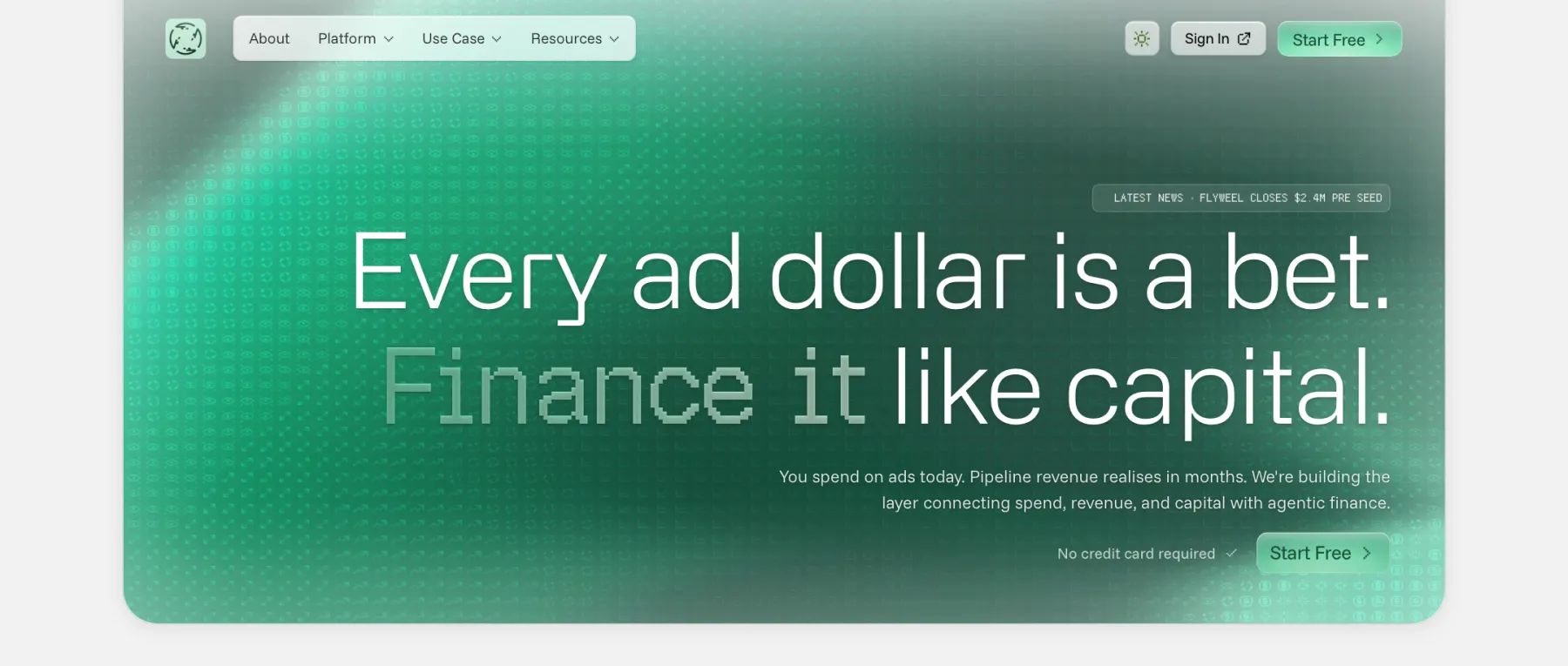
Flyweel's homepage. Ad spend management with attribution and reconciliation.
- Features2/30
- Setup3/25
- Safety10/20
- Trust1/15
- Price1/10
Flyweel is an "Ad Spend OS" with a read-only analytics MCP covering 222 metrics across Google (132), Meta (67), and TikTok (23). The MCP is free with unlimited tool calls on both tiers, the most generous free analytics offer here, and its standout is CRM-to-ad-spend attribution across 9 CRMs plus Xero invoice reconciliation.
The constraint is the section's: Flyweel reports on Meta ads, it does not run them. Eight MCP tools, one of which does actual analytics, and Meta data runs 1 to 3 hours behind. Founded in March 2025 with Antler backing, it is very new, but the free MCP and the attribution angle make it the most interesting read-only option for a finance or ops lens.
Pros
- ✓Free MCP with unlimited tool calls; the strongest free analytics MCP here
- ✓Unique CRM-to-ad-spend attribution across 9 CRMs
- ✓Xero invoice reconciliation included
- ✓Strong operational-finance founding team
Cons
- –Strictly read-only; cannot launch or manage a campaign
- –Only 8 MCP tools, one real analytics tool
- –Data freshness lags a few hours (Meta 1-3h, Google 4-6h)
- –Steep jump from free to $149/mo
Hosting
Hosted (Streamable HTTP)
Safety
Read-only, cannot spend
Trust
Antler-backed (2025)
Price
Free, then $149/mo
Side-by-side comparison
| Tool | Score | Hosting | Features | Safety | Trust | Price |
|---|---|---|---|---|---|---|
AdKit#1 | 96 / 100 | Fully hosted, ~3 clicks | 7 platforms; full write; ad library, AI creatives, strategy | Draft-first approval | Reviewed Tech Partner | Flat $29 / $49 mo |
Meta Official MCP | 78 / 100 | Hosted by Meta, OAuth | Meta only; full write; account management | No draft step | First-party (Meta) | Free, daily cap |
Adspirer | 66 / 100 | Hosted (Streamable HTTP) | Meta, Google, LinkedIn, TikTok; full write; 178 tools, no extras | New paused, live edits | Bootstrapped, no badge | Free, then $40-$167 mo |
Synter | 64 / 100 | Hosted + CLI (OSS) | 27 platforms; full write; AI creatives, no ad library | Tiered approval | VC-backed, 2026 launch | Free (read-only), then $20-$500 mo + 3% of spend |
Pipeboard | 56 / 100 | Hosted + CLI (OSS) | Meta, Google, TikTok, Snap; full write; 120+ raw API tools | Paused-default, live edits | Bootstrapped, OSS | Free; $29.90 for 3 accounts, $199 for 25 |
Blend MCP | 55 / 100 | Hosted | Meta, Google, TikTok, MS, Pinterest; full write; ecommerce-focused | Live execution, no draft | Founded 2020, $3.6M | $29-$199 mo (ops cap) |
Zuckerbot | 54 / 100 | Self-host / terminal (OSS) | Meta only; write on paid; some research / creative | Approval step | Approved Meta partner | Free, then $49-$149 mo + overage |
Ryze AI | 47 / 100 | Hosted | Meta, Google; full write; autonomous optimization | Per-action approval | Customer proof unverified | ~$43-$89 mo + credits |
Windsor.ai | 43 / 100 | Hosted SaaS | Meta as 1 of 325+ sources; reporting + basic writes | Basic writes, no approval step | SOC 2, est. 2017 | Free, then $23-$598 mo |
meta-mcp (brijr) | 42 / 100 | Self-hosted (Cloudflare) | Meta only; full write; 39 campaign / reporting tools | No approval gate | No partner status | Deploy yourself; free |
mikusnuz/meta-ads-mcp | 39 / 100 | Self-hosted (npm) | Meta only; full write; 135 tools | No approval gate | No partner status | Free, self-hosted |
hashcott/meta-ads-mcp-server | 36 / 100 | Self-host (Node/Railway) | Meta only; read default, write opt-in; 54 tools | Paused-default | Unofficial, no partner status | Free, self-hosted |
codprocess/facebook-ads-mcp | 30 / 100 | Self-host (Railway) | Meta only; basic create / update / delete | No approval gate | No partner status | Free, self-hosted |
attainmentlabs/meta-ads-mcp | 28 / 100 | Self-host (uvx/pip) | Meta only; 5 functions | Dry-run + paused default | No partner status | Free, self-hosted |
promobase/facebook-business-mcp | 23 / 100 | Self-host (uvx/pip) | Meta only; write unclear | None documented | No partner status | Free, self-hosted |
Composio | 22 / 100 | Hosted, BYO OAuth | Meta (52 tools) + 1,000 apps; generic actions, no ads extras | No draft or review | No partner status | Free, then $29/mo + usage |
Funnel.io | 21 / 100 | Hosted SaaS | Meta as 1 of 600+ sources; read-only analytics | Read-only, cannot spend | Partner status unknown | Custom, by quote |
Triple Whale | 20 / 100 | Self-host (API key) | Meta ad metrics; read-only analytics | Read-only, cannot spend | Meta partner | Paid Triple Whale plan |
Adzviser | 18 / 100 | Hosted (Streamable HTTP) | Meta among 45+ sources; read-only analytics | Read-only, cannot spend | Bootstrapped (2022) | $48.99-$148.99 mo |
Flyweel | 17 / 100 | Hosted (Streamable HTTP) | Meta, Google, TikTok; read-only; 222 metrics + CRM attribution | Read-only, cannot spend | Antler-backed (2025) | Free, then $149 mo |
How to choose a Meta Ads MCP
Match the tool to what you actually need:
- You want the safest, most complete Meta setup. Pick AdKit. Draft-first approval, a full toolkit (ad library, AI creatives, strategy), and seven ad platforms from one connection.
- You run Meta only and want first-party. Meta's official MCP is the official route, as long as you accept beta rough edges, a daily request cap, and no other channels.
- You run a long list of ad platforms. Synter covers the most (27), if you can live with credit-metered pricing and a tool that launched in 2026.
- You are a developer who wants raw API access. Pipeboard wraps Meta, Google, and TikTok into 120+ tools. Full control, but it writes to your live account, stops at the API, and is priced per ad account.
- You want continuous optimization of existing campaigns. Ryze runs an autonomous optimization engine for Meta and Google, with a per-action approval gate you can switch off. Read the trust note on its card first: we could not verify its homepage testimonials.
- You only need reporting. Read-only tools like Funnel.io or Triple Whale pull Meta data into your AI client but cannot run campaigns.
For most people running real money across real channels, the deciding factors are safety, depth, and what the tool can actually do beyond the raw API. That is why AdKit leads: a draft-first approval step so it can never spend behind your back, a full toolkit instead of a bare API, and one agent for your core channels.
Connect AdKit to Meta in 3 steps
- Sign up and start your project. Create an AdKit account and open a project for your brand. No tokens or developer setup.
- Connect your Meta account. Authorize through Meta's official flow. AdKit is a reviewed Tech Partner, so this is the sanctioned Marketing API path.
- Point your agent at AdKit. Add AdKit to Claude, ChatGPT, Cursor, or any MCP client, then ask it to audit a campaign or draft a new one. Every change waits for your approval before it goes live.
Full walkthrough: How to set up the Meta Ads MCP. Running Google too? See the Google Ads MCP guide.
Frequently asked questions
AdKit is the best Meta Ads MCP for most people. It is the safest option, since every change is saved as a draft you approve before it goes live, and the most complete, with a competitive ad library, AI creatives, and a strategy skill on top of campaign management. It runs seven ad platforms from one connection (Meta, Google, TikTok, Reddit, X, LinkedIn, and Microsoft) and is a reviewed Meta Tech Partner using the official Marketing API. Setup is hosted and takes about three clicks, with no tokens or code.
Yes. Meta launched its own official MCP server, plus a CLI, in open beta in 2026. It can create and edit campaigns, ad sets, and ads through natural language, with no developer credentials or coding required. The catch is that it only covers Meta, so you still need a separate tool for Google, TikTok, or LinkedIn.
It depends on the server. Most of the servers we rank, including AdKit, Meta's official MCP, and Composio, can write: create campaigns, edit budgets, and launch ads. Some open-source servers are read-only by default or do not clearly document write support, and a separate category of analytics MCPs can only pull reports. Always check write access before you pick one, because a read-only server cannot run your ads for you.
It is safe when the server puts a human approval step between the agent and your live account. AdKit saves every change as a draft and waits for your yes before anything goes live. Servers without that gate can spend real budget the moment the agent acts, so prefer one with a draft or approval layer.
Several servers have a free tier, including Pipeboard, Adspirer, and the read-only Flyweel, though free plans are usually capped or read-only and some paid plans add a percentage of your ad spend on top of the monthly fee. For unlimited hands-on management at a flat price, AdKit starts at $29 a month for one brand and $49 for unlimited brands, with every tool and MCP access included.
The hosted ones do. AdKit, Meta's official MCP, and Composio connect to Claude, ChatGPT, Cursor, and any MCP client through a URL or a few clicks. Open-source servers that run in your terminal, like Zuckerbot, work with local clients such as Claude Code and Cursor but need a manual install first.
Take each homepage testimonial and search the platform whose logo it shows for the reviewer and the quote, then search the named person and company. Real proof resolves in a minute. A logo with no link, a handle that returns 404, or a reviewer missing from that platform means unverified. Every vendor in this roundup passed except Ryze AI; the details are on its card.
Technically its MCP does what it claims: write access to Meta Ads with guardrails. Its customer proof does not hold up. As of 6 September 2026, none of the six homepage testimonials could be verified, including an X account that does not exist and a Trustpilot reviewer who is not on Trustpilot. We rank it 8th of 20 and treat its claims as unverified.